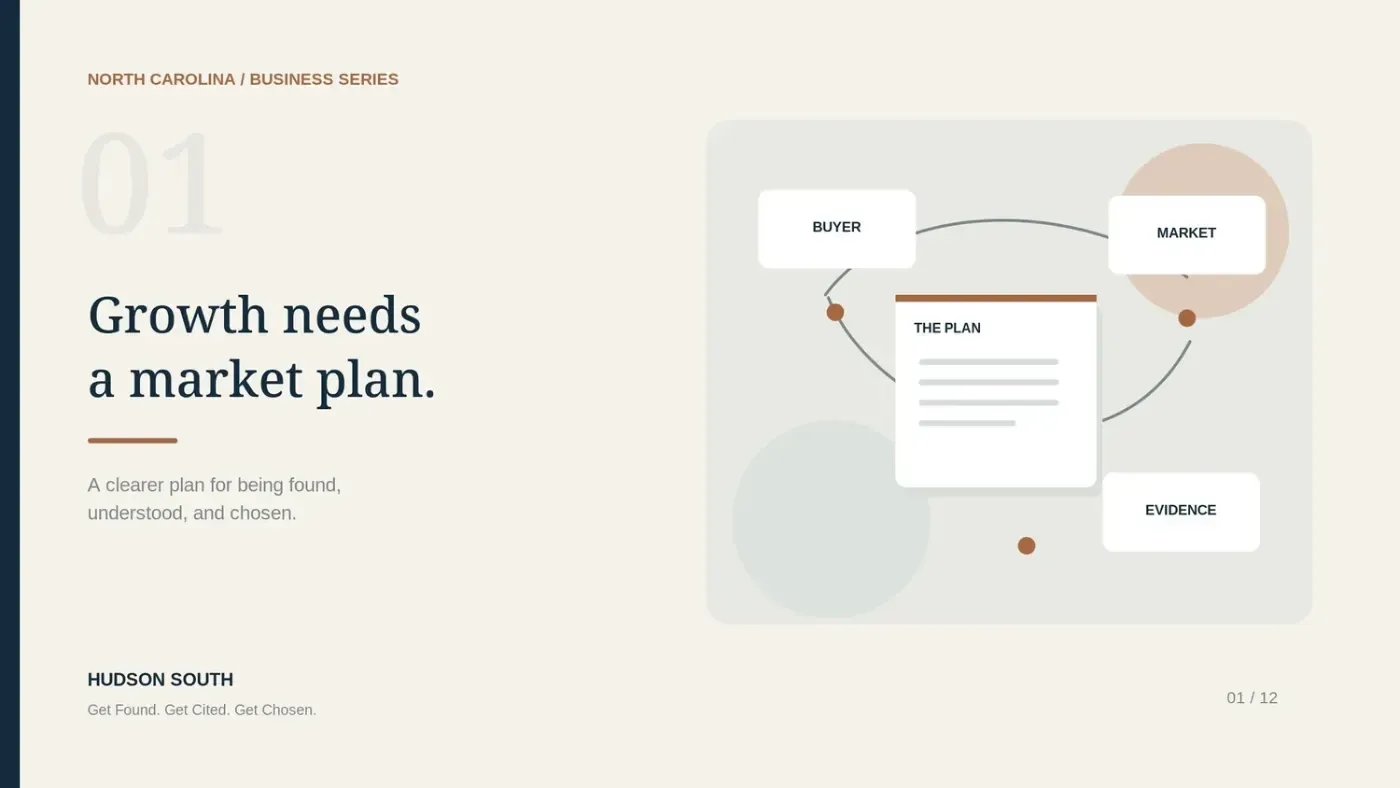
Expanding into another North Carolina market starts with a content decision, not a city-name list. Define which customers the business can serve, what those customers need to understand, and which evidence supports the offer. Then decide what deserves a new article and what belongs in existing content.
A calendar can look productive while leaving all of that unresolved. Twelve topics are approved. Writers are assigned. Someone asks for Charlotte to appear more often because Raleigh already produces inquiries. The team starts writing, even though nobody has established what a worthwhile Charlotte inquiry looks like.
That is not necessarily a writing problem. The assignment is incomplete.
A useful expansion plan gives the marketing team decisions it can work from. It also gives the business a way to judge the work beyond whether another post went live.
Start with the work you can actually deliver
“More customers across North Carolina” is a direction, not a usable brief. A commercial cleaning company, a dental practice, and a parts manufacturer have different constraints. The cleaning company needs to know where crews can reliably work. The practice needs to account for where patients attend appointments. The manufacturer may ship to buyers who will never visit the facility.
Those are three different meanings of a market. Treating them as interchangeable produces content that may attract the wrong inquiry or imply availability the business cannot support.
Write a plain description before choosing topics: the customer, the problem, the service or product, the delivery area, and the conditions that make the work suitable. Include what the business is not pursuing. An exclusion can save a writer from developing an entire series around the wrong opportunity.
North Carolina's economic development organization identifies industries ranging from manufacturing and life sciences to financial services and technology. That breadth is useful context, not evidence that every region or sector is equally attractive to a particular business. EDPNC's industry overview is a starting point for investigation, not a substitute for your own customer and operating information.
Give each market a reason to be on the list
Choose one customer decision in one market and complete the following brief. Do not turn the exercise into an invented numerical score. A blank field identifies a missing decision, not a low-ranking website.
| Planning question | What a usable answer contains |
|---|---|
| Who are we trying to reach? | A customer type and a situation, not everyone within a city. |
| Can we serve that person or company? | Confirmed delivery, appointment, shipping, or operational limits. |
| What must they understand before contacting us? | One consequential question, comparison, or concern. |
| What evidence can we publish? | Approved process details, examples, capabilities, or documented results. |
| Where should the answer live? | An existing article to improve or a clearly distinct new blog. |
| Who owns the facts? | The person who can verify the explanation and keep it current. |
| What would make the work worthwhile? | A defined type of qualified inquiry, not just additional visits. |
A market with a credible offer, useful evidence, and capacity to respond may deserve attention before a larger market selected only because its name appears on a keyword list.
That is a business judgment. Search data can inform it, but search volume alone cannot make the engagement profitable or operationally sensible.
Two markets can require very different content
Consider two hypothetical businesses. These are planning examples, not Hudson South client results.
A Triangle commercial cleaning company wants recurring office work in another serviceable part of its existing territory. Sales keeps answering questions about building access, the walkthrough, and how the cleaning scope is agreed. Its next article could explain what a facilities manager should expect from that walkthrough and what information affects a proposal. Location details belong in the article where they change service access or process, not in every heading.
A Greensboro manufacturer wants more out-of-state buyers. It can ship nationally, but prospects cannot tell whether it accepts short runs or what drawings are needed for a quote. The priority is a supplier-evaluation article using approved capability and quote information. A dozen Greensboro keyword variations would not answer that buyer's question.
Both businesses are expanding their reach. One needs to explain a local service relationship; the other needs to help a remote buyer assess production fit. The editorial plan should reflect that difference.
Separate the outcomes before measuring progress
Being found through a branded search, appearing in a map result, earning an ordinary search visit, and being cited in an AI answer are not the same observation. Keep them in separate columns when reviewing the work.
A city name in an article does not establish a physical presence. A screenshot of an AI answer does not establish how many people saw the business. An inquiry does not become an AI-generated lead just because the company has started publishing AI-search content.
For Google AI Overviews and AI Mode, the documented starting point is ordinary SEO eligibility and helpful content, not a separate required schema or special AI file. Google also makes clear that eligibility does not guarantee inclusion. Google's guidance for AI features supports doing the fundamentals well rather than selling a guaranteed placement formula.
For the practical comparison, use the Raleigh-versus-Charlotte visibility check. It explains how to record comparable observations before deciding what needs to change.
Keep the useful common material
Some facts should stay consistent everywhere: how the business works, its actual capabilities, the meaning of its offers, and the responsibilities a customer can expect. Local research should refine those facts where necessary, not create a different identity for every city.
A separate article earns its place when it resolves a different decision. A local requirement, delivery limitation, or appointment arrangement might justify a follow-up. A new town name in an otherwise unchanged paragraph does not.
Use the Triangle reuse-or-localize test before turning a single topic into several posts. It is usually more useful to complete one strong explanation and make it easy to find than to spread the same unfinished answer across more URLs.
Turn the decisions into a working content plan
At Hudson South, the sequence is Authority Asset, Hudson Twenty-One, Market Intelligence, and AEO Creation. The Authority Asset captures the business knowledge and supporting facts. Hudson Twenty-One establishes how that knowledge should sound. Market Intelligence investigates the markets and questions that matter. AEO Creation turns those inputs into connected, readable content.
The sequence matters because production should not have to invent the missing decisions. A writer cannot responsibly manufacture a service boundary, a supplier capability, or a customer outcome to make a brief feel complete.
Start with one market, one valuable customer situation, and one answer your business can support. Give that article an owner, an appropriate next step, and a way to evaluate the inquiries it produces. Then use what you learn to decide where the next piece belongs.
The goal is not a larger collection of city names. It is a body of content that makes your business understandable to the customers you can genuinely help.
Continue through the series: Why Your Business Shows Up in Raleigh but Not Charlotte; Raleigh, Cary, and Durham Do Not Need Three Copies of Your Blog; How to Find the Content Gaps Your Charlotte Competitors Leave Open; Winning New Customers Before They Know Your North Carolina Brand; When Your North Carolina Ads Outrun Your Website Content.
Build the plan before the calendar
Discuss how your customer priorities, markets, and business knowledge can become a connected content plan with Hudson South.
Schedule a 30-minute conversation