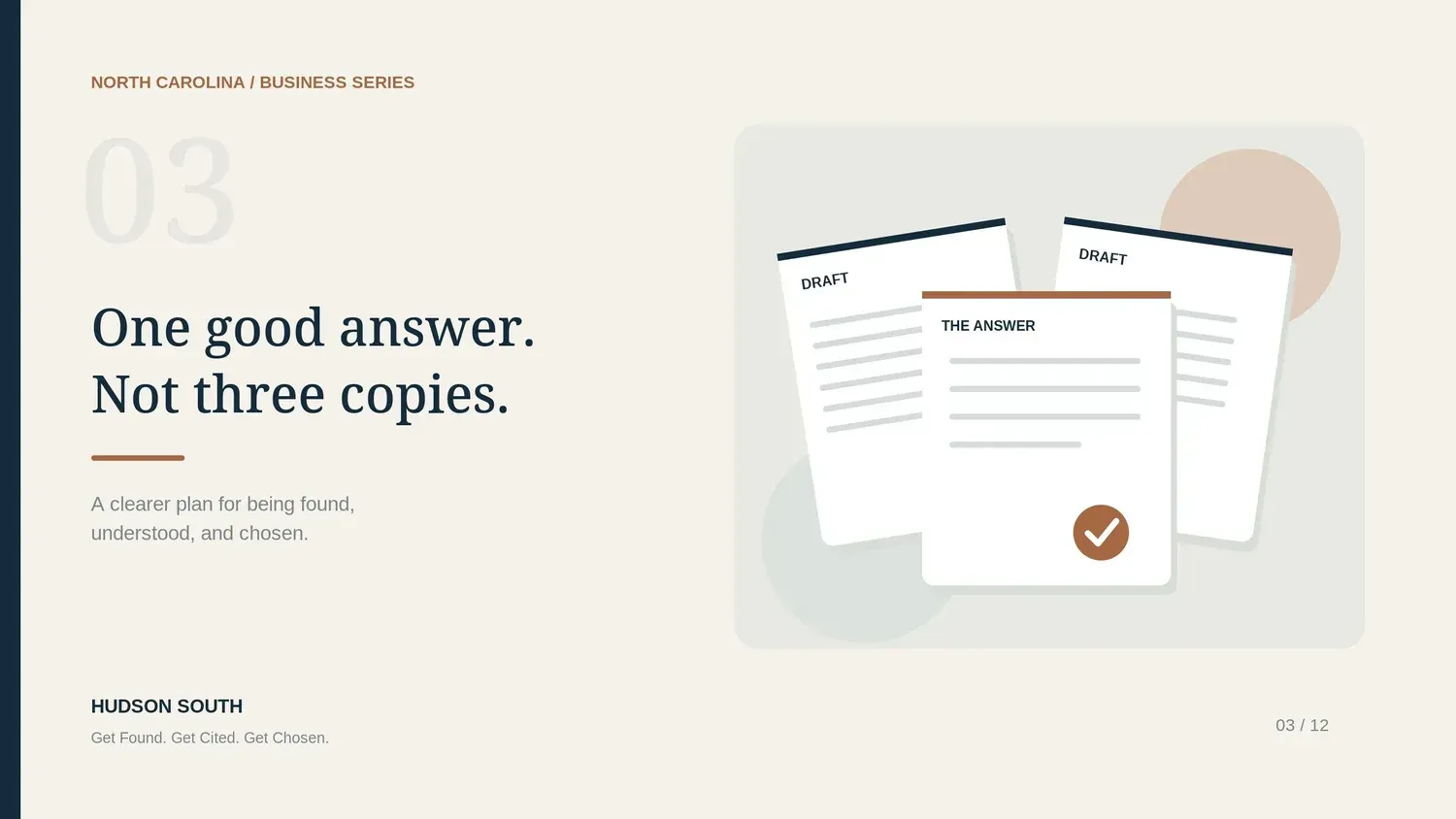
Separate blogs for Raleigh, Cary, and Durham are useful only when the location changes the reader's question or the answer. Shared business facts should stay consistent. Create a distinct local article when verified differences change the decision, not simply because the city names create three keyword opportunities.
A content calendar can turn one sensible topic into three weak assignments very quickly. Write about remodeling in Raleigh. Repeat for Cary. Repeat for Durham. The introductions change, but the advice underneath does not.
That approach gives the writer a place name without giving the article a reason to exist. The more useful question is what a reader in each location actually needs to understand differently.
Local relevance has to do work in the article
A paragraph about a downtown, a university, or regional growth can sound local while contributing nothing to the buying decision. It does not explain service reach, project requirements, delivery, access, or what happens next.
Take a hypothetical remodeling company serving the Triangle. Its method for documenting a project scope may be consistent across its territory. A blog explaining that method does not automatically need three versions.
The source of permitting information, however, can matter to the explanation. Raleigh publishes a specific page about screened porches, decks, and balconies, with application prerequisites. That official Raleigh resource illustrates a legitimate local research input. It is not evidence that the same instructions govern every nearby property.
For an article about another jurisdiction, the writer must verify the appropriate authority and the actual project conditions. The business's marketing team should not infer those from a mailing address or replace “Raleigh” with “Durham” in a legal or permitting statement.
The difference earns a place in the content because it changes what needs to be checked, not because a city name looks good in the title.
Decide what stays shared and what needs separate treatment
Use this test before approving a local variation:
| Proposed difference | Appropriate editorial response |
|---|---|
| Only the city name changes | Keep one useful article rather than create another copy. |
| The service is identical but access arrangements differ | Explain the verified arrangements in a focused section or existing location resource. |
| A different authority or requirement changes the answer | Research the applicable source; decide whether the difference needs a full article. |
| A materially different customer situation needs different evidence | Develop a new article around that situation, with geography where it matters. |
| The company does not actually serve the location | Do not imply availability to justify the target. |
A separate URL should be an editorial conclusion, not the starting requirement.
Google's doorway-abuse policy addresses substantially similar regional pages that funnel users to a more useful destination. Its keyword-stuffing examples also include city lists that add little value. The policy applies to web content, whether the page is labeled a blog or something else. A blog category does not excuse repetition.
Compare two content briefs
An incomplete brief might read: “Write 1,000 words on choosing a remodeler in Cary. Use the city throughout and mention our service area.”
The writer still does not know which project the article concerns, what customers misunderstand, what evidence is available, or what makes Cary relevant. A model can generate polished sentences around that uncertainty. It cannot turn the missing business decisions into verified facts.
A stronger hypothetical brief is more specific: “Explain how our project walkthrough distinguishes an early budget discussion from an agreed scope. Use the approved process, identify what must be inspected, and link to the appropriate authority when a local requirement matters. The audience is a homeowner comparing proposals, not someone seeking DIY instructions.”
That brief may result in one strong Triangle-wide article. It may also reveal a worthwhile local follow-up after the actual research. Either result is better than declaring three posts necessary before asking the question.
The same test works outside home services. A practice may share a general article about the purpose of a first consultation while maintaining separate practical information for each actual office. A retailer may explain a product comparison once and link to current availability at the relevant store.
Preserve context when a passage is read separately
If a location materially limits the answer, keep it close to the statement. “Appointments are available on Saturday” is incomplete if only one office offers them. “Delivery is included” is incomplete if it applies only to a defined area or order type.
Write the actual condition into the explanation rather than relying on a location buried in a footer. That helps a reader who lands midway through the article or encounters a passage quoted elsewhere.
This is a clarity practice, not a promise about which sentence an AI system will select. There is no need to make every paragraph a miniature city page. The objective is to avoid allowing an isolated passage to say more than the business can support.
Do not erase useful pages just to simplify the plan
A weak local-content strategy does not justify deleting existing URLs without reviewing their purpose and performance. Some pages may have useful references, legitimate local details, or a distinct customer role that is not obvious from the title.
Inventory first. Compare actual content. Check which page should own the subject. Decide whether to improve, connect, or consolidate with the person responsible for the site. A publishing cleanup should not casually discard material that customers already use.
For new work, maintain a short record of why each article is distinct. If that explanation cannot be written without mentioning a keyword target, return to the brief.
Give the marketing team permission to reject duplication
A writer should be able to say that a separate Cary version is not justified yet. That is not resistance to local growth. It is a request for a better reason to use the budget.
The useful output might be one complete article, a verified local note, and a focused follow-up question for operations. It might be a genuinely different article backed by a different source. The answer depends on the work, not on a required number of city posts.
A multi-market content plan should make those judgments explicit. Raleigh, Cary, and Durham can all matter to your business without requiring three copies of the same explanation.
From the series: How North Carolina Businesses Can Compete in More Than One Market.
Give each local article a reason to exist
Discuss which explanations should stay shared, which local questions warrant research, and how to avoid a calendar full of repeated answers.
Schedule a 30-minute conversation