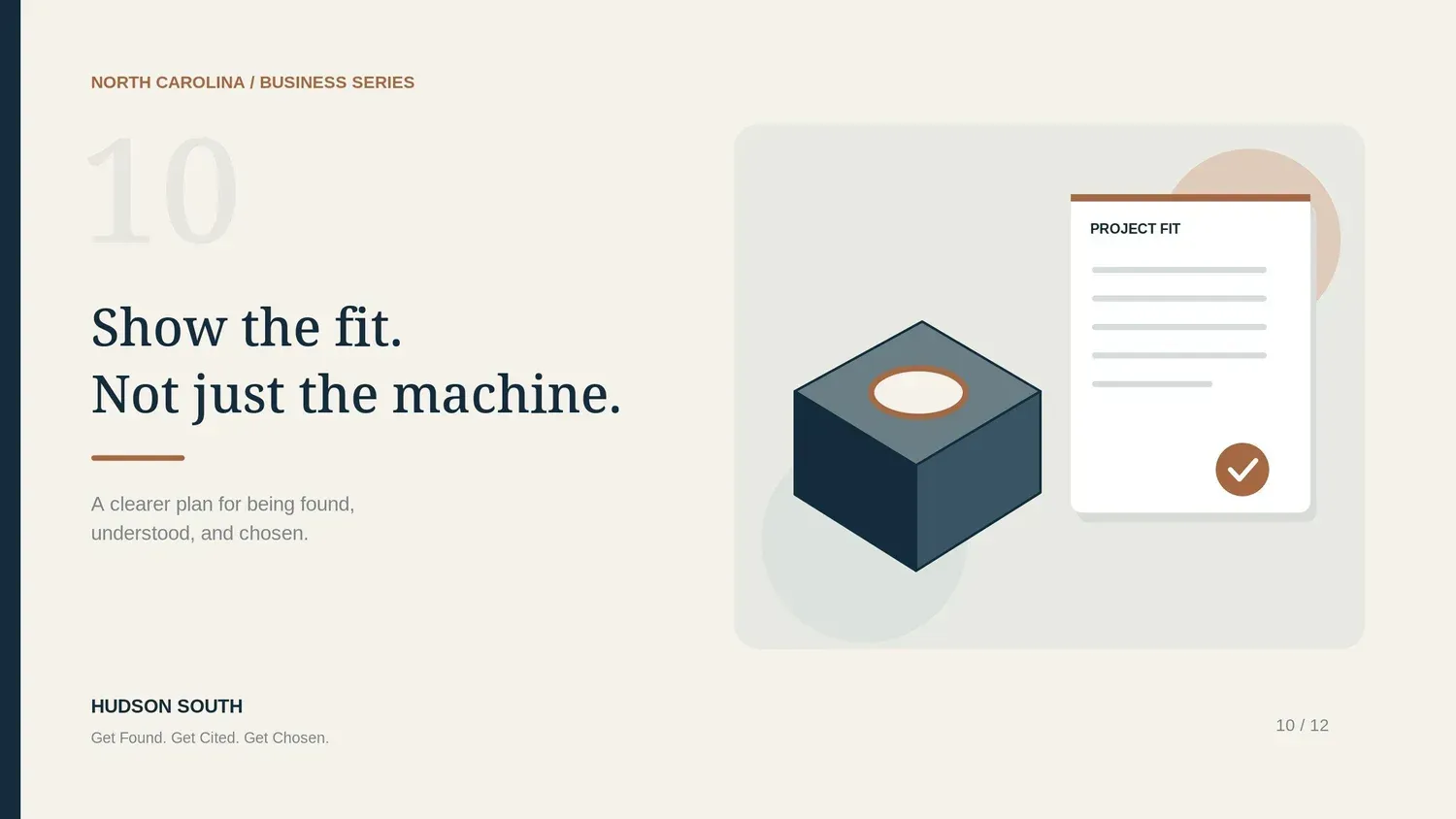
A manufacturer's website should help a buyer assess whether a project is worth discussing, not merely identify the machines on the floor. For a North Carolina supplier, useful content connects approved capabilities, limits, applications, and quote requirements. Technical claims need the responsible team's approval before marketing turns them into promises.
An equipment list can be precise and still leave a buyer guessing.
The machine name does not necessarily explain whether the shop accepts the project type, what information engineering needs, how the work will be assessed, or what must remain confidential. Those questions belong in the content plan before someone assigns another broad article about where manufacturing is headed.
The buyer is trying to reduce uncertainty. Give the marketing team the information needed to help them do that.
Translate the list into a project discussion
Start with the question each capability helps a buyer answer. Do not assume that naming a process tells every prospect how it applies to the work they need.
Charlotte Industries' homepage provides one useful example of application-oriented writing. Alongside machining services, it describes work associated with sectors such as food manufacturing, packaging, and transit, including examples of replacement-part needs. That is an observation about the published description, not an independent verification of its capabilities or certifications.
The editorial lesson is the connection between a service and a buyer's situation. Your business should make that connection using its own approved facts.
A machine specification can remain valuable to a technical buyer. It simply should not carry the entire explanation by itself.
Build the capability-to-question table with the right people
| Material available to marketing | The question it should help answer | What must be approved |
|---|---|---|
| Equipment or process list | Is this a process the project may require? | The actual equipment, process scope, and limitations. |
| Material or application examples | Has the business described work relevant to this project? | The specific materials and applications that can be stated publicly. |
| Project-volume information | Does this type of order fit the supplier's operating model? | What can be said about prototypes, short runs, or production work. |
| Quality documentation | What documentation can the buyer discuss or request? | Current scope, availability, and any certification claim. |
| Quote instructions | What is needed to begin a productive assessment? | Required inputs and the appropriate information-sharing channel. |
This table is not a suggested capability list. It is a way to find the source owner before the writer makes an assertion.
Engineering may own one part of the explanation, quality another, and sales or operations the quote process. A generic “approved by marketing” field does not replace those responsibilities.
Describe constraints without publishing confidential information
Not every useful fact belongs on a public page. A project can involve confidential designs, contractual restrictions, or information that needs an approved handling process. Marketing should know what it can publish and what requires a private, controlled discussion.
Explain how to start the conversation without asking a buyer to place sensitive drawings into an unsuitable form or ordinary public comment. Do not claim a channel is secure, certified, or suitable for controlled information unless the responsible team has established that fact.
The public article can identify the types of questions a buyer should prepare to discuss. It does not need to publish customer drawings, proprietary setups, or undisclosed production details.
Specificity and confidentiality are not opposites. The right boundary lets the business be useful about its process while protecting information that does not belong in marketing.
Give the quote request a purpose
A form may collect a name, a company, and a service selection without explaining what happens next. That can be an appropriate first contact, but it should not be described as a completed technical assessment.
Build a hypothetical quote-preparation article around the buyer's decision: “What information helps us decide whether to review your project?” The source brief might cover the project type, intended application, relevant requirements, desired timing, and the approved route for discussing drawings.
Engineering and sales should decide which fields are needed at the first step. Marketing should not require a full technical submission merely because a longer form looks more thorough. Nor should it promise a quote before the necessary assessment has happened.
The article's job is to set up a useful exchange, not make the qualification decision on behalf of the production team.
Let North Carolina describe the business, not limit the buyer
A Greensboro, High Point, or other North Carolina manufacturer may serve customers far beyond its immediate area. The relevant geography might concern shipping, plant visits, service support, or a customer's sourcing preferences rather than a local map result.
Manufactured in North Carolina offers a public supplier database with profiles that highlight products and capabilities. That is a useful example of how a buyer can encounter a company outside its own website. It does not establish that a listing will generate an inquiry or an AI citation.
Use consistent, current descriptions across legitimate public profiles and the business's own content. A directory profile that promises one scope while an article describes another creates avoidable uncertainty.
The unfamiliar-buyer content path explains how to connect that discovery to useful evaluation material rather than assume the reader already knows the supplier.
Do not let AI fill engineering blanks
A model can produce plausible numbers, materials, standards, and lead times. Plausible is not approved.
If the source brief contains an unresolved capacity, tolerance, certification, or turnaround question, keep it out of publication until the responsible person resolves it. Do not turn a typical industry figure into a claim about your shop. Do not use a competitor's specification to complete your own capabilities section.
When a technical condition changes the meaning, keep it beside the claim. A value without its material, process, inspection context, or other necessary limitation may say more than engineering intended.
This is also the useful meaning of extraction readiness here: a passage should retain its intended scope when read separately. It is not a prediction about an AI system's private retrieval behavior.
Measure better conversations, not just more form fills
Work with sales to define an inquiry that is suitable for the business. Track what the content can reasonably influence: whether prospects understand the offered work, provide appropriate first-step information, and reach the right conversation.
Do not promise that clearer articles will eliminate every unsuitable inquiry or shorten every sales cycle. Those are outcomes to observe, not assurances to insert into the brief.
The practical improvement is a website that gives a buyer enough reliable information to decide whether to engage. The machine list remains part of that explanation. It stops being the whole story.
From the series: Why One AI Content Playbook Fails Across North Carolina Industries.
Help the right buyer recognize a fit
Talk with Hudson South about turning approved engineering, sales, and operations knowledge into content that supports a useful supplier conversation.
Schedule a 30-minute conversation