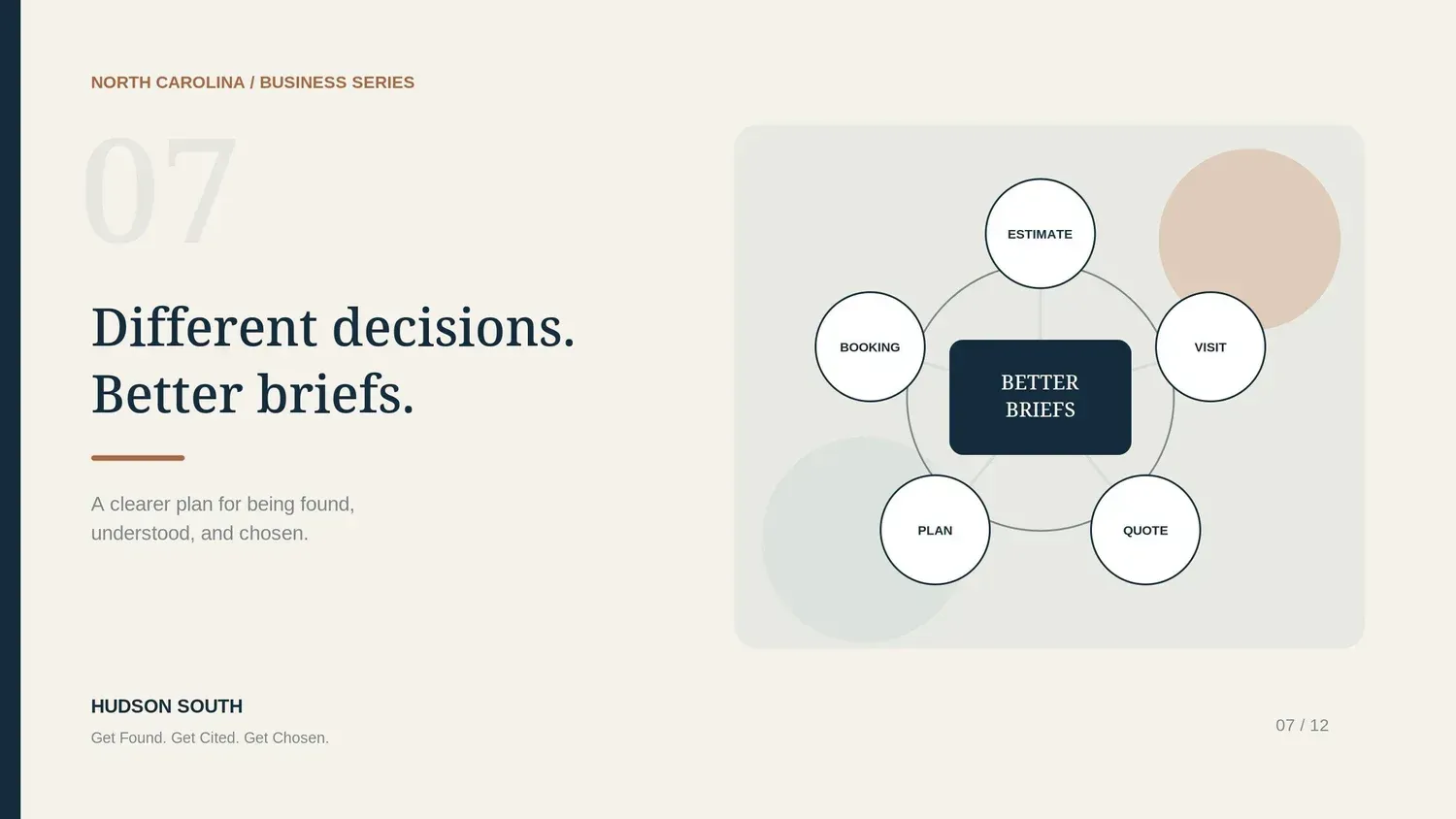
An effective AI-assisted content plan starts with the customer's decision, not a reusable article outline. North Carolina contractors, healthcare practices, manufacturers, financial businesses, and visitor-facing companies need different facts, evidence, and review. A common production process can support them, but a generic brief cannot supply the missing business knowledge.
Two posts a week. A monthly keyword list. An AI writing tool. A review step before publication.
That can describe a well-organized production process. It does not tell us whether the content helps anyone choose the business.
The missing decisions become easier to see when you compare industries. The information needed before an HVAC estimate is not the information needed before a supplier quote. A first healthcare appointment is not the same commitment as a retail reservation. Yet a single template can make all four sound almost identical.
The team may be doing exactly what the system asks. The system needs better inputs.
Compare the decision before comparing the writing
A useful cross-industry review starts with what the customer is trying to establish. It then identifies who inside the business knows the answer and who needs to approve it.
| Business situation | The customer's immediate decision | Facts the content team needs | Appropriate fact owner |
|---|---|---|---|
| Contractor estimate | Whether the proposed process fits the project. | Scope, inspection needs, options, exclusions, and confirmation steps. | Estimating and operations. |
| First healthcare visit | Whether and how to request the appropriate appointment. | Visit purpose, scheduling, approved preparation, and payment information. | Practice operations and the relevant clinician. |
| Manufacturing inquiry | Whether the supplier merits a project discussion. | Capabilities, constraints, quote inputs, and information-handling requirements. | Engineering, quality, sales, and operations. |
| Financial engagement | Whether the service and relationship fit the client's situation. | Actual scope, fee basis, first conversation, and applicable limitations. | Service leadership and the appropriate compliance reviewer. |
| Planned visit or purchase | Whether the experience or product fits the intended visit. | Suitability, logistics, availability source, and reservation meaning. | Location, customer service, or booking operations. |
This is an editorial comparison, not a claim that every business within each category follows the same process. It shows why the brief needs to come from the company rather than from a generic description of its industry.
A template can organize an answer, not establish it
Templates are not inherently bad. They can keep fields from being missed and help a team publish consistently. The problem begins when the template supplies apparent facts instead of asking for them.
A paragraph about personalized service may sound appropriate in a clinic, a machine shop, and an advisory practice. It still does not explain what each business actually does. A standard FAQ might confidently invent a turnaround time, consultation fee, service area, or review process because the writer expects every page to contain an answer.
Leave an unconfirmed field unresolved in the brief until the business can supply it. Do not allow a polished draft to make the decision by default.
Google's guidance on helpful content asks whether a page contributes original information, analysis, and value rather than merely repeating existing material. That editorial guidance is more useful here than trying to discover a universal article shape for AI citations.
Make the source conversation concrete
“Tell us what makes the business different” is difficult to answer well. It invites slogans. Ask for an actual decision instead.
For a contractor: what do you still need to know before you can agree on a scope?
For a manufacturer: what arrives in a quote request that makes it impossible to assess the job?
For a practice: what do people assume the first appointment includes that you need to clarify?
For a retailer: when does a customer believe an item is reserved when it is not?
These questions can produce specific explanations and conditions. They also identify what should not be generalized. One customer's project or experience is not automatically a standard promise to everyone.
Record the answer, the person responsible for it, the date, and any limit on public use. A useful content system preserves those distinctions instead of asking the writer to reconstruct them each month.
Give the article one substantial job
A marketing team should be able to explain why a proposed article is separate from the rest of the site. “We have not used this keyword yet” is not enough.
An estimate article can explain how a customer compares scope. A supplier article can explain how to prepare an appropriate inquiry. An appointment article can explain the purpose and process of the first visit. Each needs enough depth to resolve its question, not a fixed word count borrowed from another industry.
The supporting posts in this series apply those distinctions to contractors, healthcare practices, manufacturers, financial businesses, and hospitality and retail. They are starting examples, not a limit on who Hudson South serves.
For technology, the decision might concern implementation responsibilities. For logistics, it could concern shipment fit and the information needed to price the work. For education or a nonprofit, it may involve eligibility, participation, or the next contact. The brief changes with the decision.
Treat extraction as a context test, not a score
Read a proposed answer without the surrounding page. Does it identify the service, the customer situation, and the condition that makes it accurate?
“Quotes are free” says too much if only replacement estimates are free and diagnostic visits are not. “We handle the full process” says little unless the process and responsibilities are defined. “Available statewide” may require a distinction between remote advice, shipping, and physical service.
Restoring the relevant context helps people who arrive through a quotation, search result, or summary. It does not mean an agency can certify how every AI system will extract the passage. Avoid proprietary-sounding percentages or scores unless the measurement method and its limited meaning are genuinely defined.
The important check is whether the explanation remains faithful to the approved business facts.
Build different review into one dependable workflow
A spelling review cannot validate a clinical claim. A general marketing approval cannot establish a production tolerance. Financial-service copy may need a reviewer who understands the firm's actual regulatory obligations. That does not require making every article unreadable. It requires assigning the right person to the right question.
Separate operational facts from claims that need technical or professional approval. Resolve those issues before the copy becomes an image caption, excerpt, social post, or page summary. Then compare the versions so that shortening the text does not remove a necessary limitation.
This is where scale should come from: reuse the approved knowledge and the review record, not unsupported assertions.
Put the business knowledge ahead of the calendar
Hudson South's four-step process connects Authority Asset, Hudson Twenty-One, Market Intelligence, and AEO Creation. The work begins with what the business knows and can substantiate, preserves how it communicates, investigates the relevant market questions, and develops the content from those inputs.
That leaves the marketing team with something more useful than a quota. It provides the source material, the purpose of each piece, and a way to keep the output consistent with the actual business.
The need is not for an AI tool that sounds equally confident about every industry. It is for a content process that knows which questions must be answered before the tool starts writing.
Continue through the series: NC Contractors: Your Next Blog Should Explain the Estimate; NC Healthcare Practices: Explain the First Visit Before the Procedure; NC Manufacturers: Your Website Lists Equipment. Can Buyers Qualify You?; NC Financial Firms: Content Needs More Than Market Commentary; NC Hospitality and Retail: Help People Plan the Visit.
Give the writing system better inputs
Discuss how Hudson South can organize your knowledge, voice, market questions, and content production around the decisions your customers actually make.
Schedule a 30-minute conversation