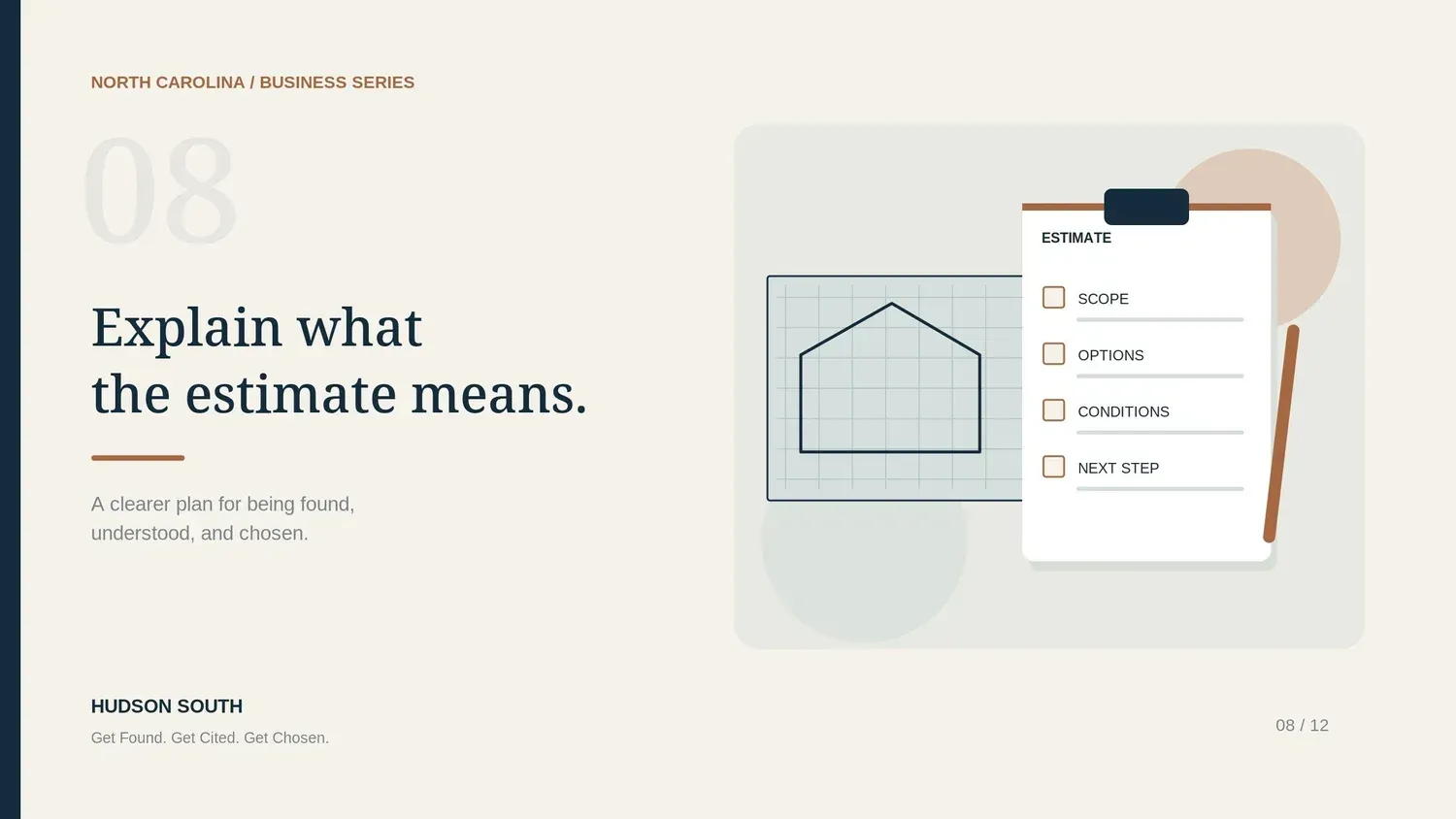
Contractor content should help customers understand what an estimate represents, which facts affect the scope, and what happens before work is agreed. For a North Carolina contractor, those explanations should come from the estimating and operations teams. An AI-generated maintenance article cannot establish the company's actual pricing or project process.
Your team may already have a folder full of maintenance tips. The next conversation with a prospective customer may still begin with the same confusion: why does this proposal differ from another one, and what exactly is included?
Another seasonal article will not necessarily settle that question. An explanation of your estimate process might.
This is a content-planning issue for contractors, not a recommendation about which system or repair a homeowner should purchase.
The word estimate needs an explanation
An early budget discussion, an online estimate, a site assessment, and a final written scope can be different steps. Your business needs to define which ones it actually uses and what each step means.
There is a useful public example in Charlotte. Andersen Heating & Cooling's online-estimate article explains that the online result is a starting point and that final pricing is confirmed after an in-home visit. The article demonstrates a distinction worth making; it is not a process every contractor should claim to follow. We reviewed the published explanation, not the calculator's output or a customer transaction.
A roofer, plumber, remodeler, and HVAC company may need different information before proposing work. Even two companies in the same trade may structure that conversation differently. The writing brief should preserve those differences.
Ask estimating for the information behind the number
A request to “write about estimate pricing” is too broad. Ask the person preparing proposals which assumptions must be clarified before the number makes sense.
What is visible during the initial conversation? What requires an assessment? What work is included? What is expressly outside the scope? Which choices affect the proposal? How are changes reviewed and agreed?
Do not publish a universal price range just to make the article feel more concrete. A number without its basis can leave the reader with a false expectation. If the business chooses to publish pricing, the responsible team must approve the scope, date, assumptions, and limitations around it.
The same applies to timing and savings. A writer should not infer installation availability or energy savings from a manufacturer's general material or another contractor's page.
Build a brief around one customer decision
Here is a hypothetical brief for a North Carolina remodeling company. It is a planning example, not a description of a specific contractor's practice.
| Brief field | Example of the information to establish |
|---|---|
| Reader situation | A homeowner comparing two proposals that describe the work differently. |
| Main question | Which scope differences should be clarified before comparing the totals? |
| Source conversation | The estimator explains the approved proposal format and common points of confusion. |
| Approved evidence | A fictionalized scope example, process explanation, and permitted project photographs. |
| Limits | No invented prices, material specifications, permit conclusions, or completion promises. |
| Next step | The company's actual method for requesting a scope discussion. |
The article can then walk through how to read the company's own proposal: what is specified, what remains conditional, and where to ask for clarification.
It should not coach the reader to perform electrical, structural, or other potentially hazardous work. That is outside the marketing question and outside what a generic content brief can safely establish.
Show the difference without disparaging another contractor
A lower total does not prove a competing proposal is incomplete. A higher total does not prove superior quality. The comparison must begin with what each proposal actually covers.
For public content, use a clearly labeled hypothetical comparison unless the company has permission and sufficient context to discuss real documents. Keep the example modest: one proposal lists a responsibility explicitly, while the other needs clarification. The conclusion is to ask about the scope, not to declare a winner.
That tone is useful to the business buying your services, too. It demonstrates the contractor's process without requiring a claim that everyone else is careless.
A marketing team that can explain this distinction gives customers a better reason to continue the conversation than another paragraph about being trusted and reliable.
Keep location relevant without inventing local rules
A company working in the Triangle or along the coast should not use location as a shortcut for technical or permitting claims. Verify the actual project, the responsible authority, and the business's process before describing a requirement.
A mailing address does not establish every applicable jurisdictional fact. A regional label does not determine the right equipment, product, or scope for an individual property.
For content planning, identify who confirms those details and explain when that confirmation occurs. When an official source is necessary, use the appropriate current source rather than a neighboring city's instructions. The Triangle local-content test explains how to decide whether a difference justifies another article.
Give the answer enough context to travel
Read the article's main explanation by itself. Does it say which estimate is being discussed? Does it distinguish preliminary information from an agreed scope? Are the relevant conditions attached to the claim?
A passage saying “our estimates include everything” may be especially difficult to defend. An approved explanation naming the actual included responsibilities is more useful. So is a clear statement of what requires further assessment.
This matters when the article is shortened into an excerpt or quoted in another context. It is a practical clarity test, not a prediction of AI citations.
Connect the article to the real intake process
The next step should match the explanation. If the article describes a scope discussion, the destination should not silently turn it into a confirmed service appointment. If the form requests a preferred time, do not describe that as an available booking unless the system actually confirms it.
Review the ad, the article, the inquiry page, and the follow-up together. The ad-to-content audit helps separate missing explanations from problems that require a form or operational correction.
Then give the article an owner. If the company changes its estimate process, proposal format, or included responsibilities, that person should notify the content team. An accurate explanation is not finished forever when it is published.
Your estimating team already holds much of the material a useful article needs. The marketing job is to capture it, verify it, and make it clear enough that a prospective customer can ask a better next question.
From the series: Why One AI Content Playbook Fails Across North Carolina Industries.
Turn estimating knowledge into useful content
Talk with Hudson South about building a content brief from your actual process instead of commissioning another generic contractor article.
Schedule a 30-minute conversation