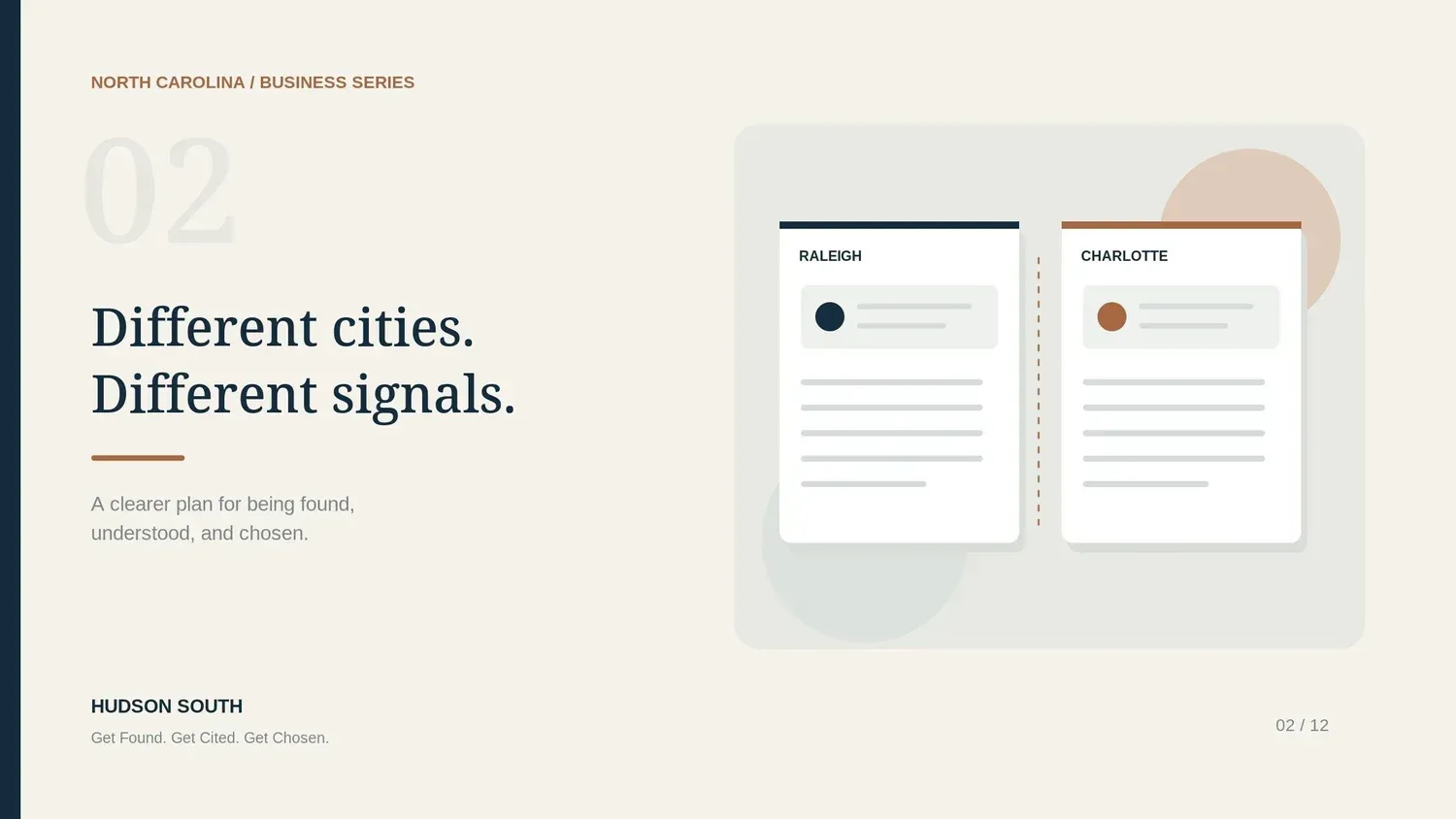
A business can appear in one North Carolina city's search results and not another for several different reasons. Before changing the content, compare the same type of result, record the location and question, and check what the business actually offers in each market. One missing mention is not a diagnosis.
“Why do we show up in Raleigh but not Charlotte?” sounds like a single marketing question. It can describe a map listing, a normal search result, an AI-generated response, or a referral report. Those observations require different checks.
The fastest way to waste a content budget is to treat them as the same problem and order more Charlotte articles.
First, establish what was actually compared
Ask for the original query and a record of the result. A search for the business name in Raleigh is not comparable to a category search in Charlotte. A logged-in assistant's answer to a long conversation is not the same test as a new conversation with an explicitly stated location.
The location the person intended also matters. “A Charlotte supplier” could mean a company physically based there, a company that delivers there, or a supplier serving a Charlotte buyer from elsewhere. Your content plan needs to know which requirement matters.
Use a simple observation log before making recommendations:
| Record | Why it belongs in the comparison |
|---|---|
| Exact query or prompt | Keeps a brand search separate from an unbranded buying question. |
| Search surface | Distinguishes Maps, ordinary results, AI Mode, or a named assistant. |
| Location supplied and device location, when known | Shows whether the two observations used the same location assumptions. |
| Date, account context, and follow-up questions | Preserves conditions that may affect what was returned. |
| Business mention and linked URL | Separates a name appearing from a page actually being cited. |
| Next observation or limitation | Prevents one screenshot from being treated as a stable market result. |
This is a proposed logging method. It is not a report of live ranking or AI-answer tests conducted for this article.
Maps visibility is not statewide organic visibility
Google describes relevance, distance, and prominence as its principal local-ranking factors. Distance concerns how far a business is from the searcher. More articles cannot make a real Raleigh location physically closer to someone in Charlotte. Google's local-ranking guidance is explicit about that distinction.
That does not make content irrelevant. It means a content recommendation should match the type of discovery being examined. A manufacturer that ships statewide and a practice that sees people at one office may reasonably have different goals.
Do not create an office claim, address, or Business Profile to make a visibility report look better. Explain genuine delivery or service reach instead. A blog can help a prospective customer understand remote delivery without pretending the company is physically based in that customer's city.
Check whether the website supports the intended market
Read the pages that a buyer could reasonably reach. Can someone establish that the company accepts the type of work in question? Is the delivery area clear? Is the relevant product or service explained? Does the next step fit the buyer's situation?
Suppose a hypothetical Raleigh equipment-service company can support customers in Charlotte, but only through planned visits. A generic “statewide service” sentence leaves the important condition out. An article explaining how planned service is arranged could be useful. Copy claiming immediate local availability would not be an improvement.
A second hypothetical company, a fabricator that ships finished parts, might need clearer information about quote inputs and shipping responsibilities instead. Its prospects do not necessarily need a neighborhood address. They need to establish whether the supplier can support the project.
Neither example proves that unclear content caused a missing search result. It identifies something the business can substantiate and improve while the visibility question is investigated separately.
Rule out basic access problems without guessing
Ask the person responsible for the site to inspect the actual page, its indexing status, canonical destination, and crawler access. Use the relevant platform's tools and the site's configuration. A failed request from a single research tool is not proof that Google or another crawler is blocked.
OpenAI identifies OAI-SearchBot as the crawler used for search-related discovery, distinct from GPTBot's training role. OpenAI's crawler documentation is the appropriate source for that access check. Allowing a crawler does not promise that a specific page will be chosen as a citation.
Keep the repair proportionate. A missing internal link, an accidental indexing restriction, and an article that answers the wrong question are different issues. Each needs its own evidence and action.
Inspect the sources that did appear
When an observed AI answer includes links, record the actual destinations. Examine what those pages contribute to that specific answer. One may explain a practical buying condition; another may be a directory or the business's own page.
Do not conclude that every visible element on the cited page caused its selection. You can observe the citation. You cannot see the full private selection process from the published answer.
For ordinary search, make the same distinction between observation and explanation. A competitor appearing above you is a reason to investigate, not proof that its word count, heading pattern, or number of city pages is the winning factor.
The Charlotte competitor-content review shows how to turn visible page evidence into a useful writing decision without claiming access to a competitor's performance data.
Match the finding to the action
If the comparison used different questions, repeat it on a consistent basis before commissioning work. If the business cannot serve the market, reconsider the target. If the website leaves a genuine service condition unexplained, supply the missing information. If the page has a verified access problem, address that first.
Then maintain a consistent observation set and assess real inquiries. Keep the type of service requested and the market involved alongside the lead, where your systems and permissions support that information.
A useful report may say that a relevant article is now accessible, its service explanation is clearer, and several recorded queries still produce different results. That is more informative than turning one favorable screenshot into a claim that the city has been won.
The work starts with a fair comparison. The content plan comes after the finding, not before it.
From the series: How North Carolina Businesses Can Compete in More Than One Market.
Find the question behind the visibility gap
Talk with Hudson South about separating the observations from the assumptions and deciding which content improvements deserve attention.
Schedule a 30-minute conversation