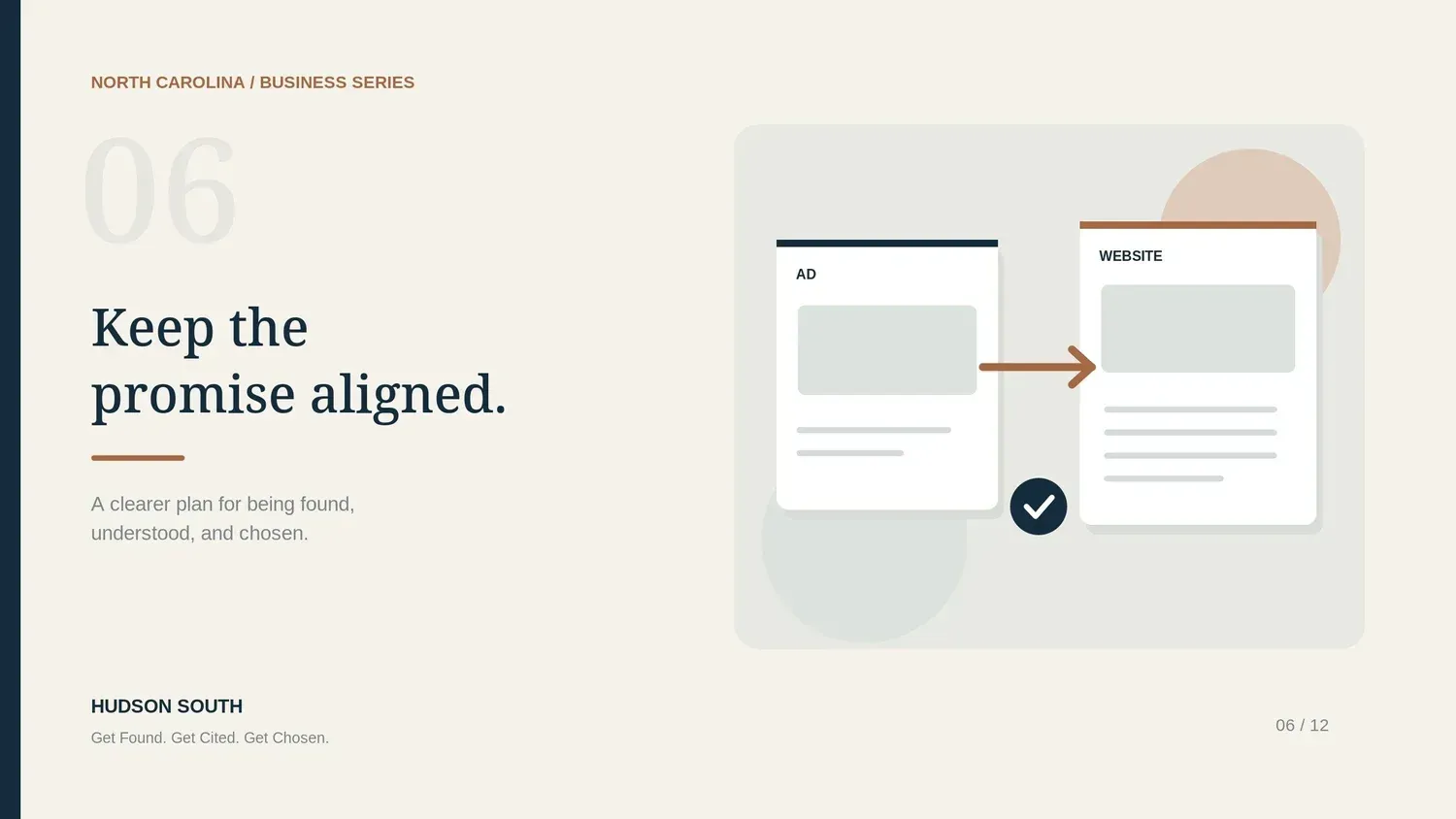
When an advertisement promises more than the destination explains, the first task is to reconcile the message, conditions, and next step. A North Carolina business should identify whether the gap belongs on the existing page, in a supporting article, or in the booking or inquiry process before increasing content production.
The ad is specific. The destination is vague. Someone asks why the campaign is not producing enough good inquiries, and the content team is assigned more blogs.
That response may miss the problem entirely. An article can explain a buying decision, but it cannot compensate for an offer that changes between the ad and the page or a form that fails to deliver the request.
Review one complete path before prescribing more traffic or more writing.
Read the promise as a prospective customer would
Start with the actual ad, its intended audience, and the destination a click opens. Record the offer as it appears, including visible qualifications. Then describe what a reasonable person would expect to do next.
The following examples are hypothetical, not observations from live campaigns.
A Charlotte HVAC ad offers a replacement estimate. The destination invites visitors to “request service” without explaining whether they are booking a diagnostic visit or beginning a replacement discussion. A healthcare ad invites a consultation, but the next page talks only about a procedure. A Wilmington retailer promotes an in-store appointment while the destination provides no way to confirm what the appointment includes.
None of those examples proves the campaign will fail. Each identifies an uncertainty that the business should be able to resolve.
Google Ads treats landing-page experience as one component of its Search campaign Quality Score diagnostic. Its documentation is useful context for examining the destination, but a Quality Score is not a business-result guarantee and does not establish what is wrong with an individual campaign.
Give each part of the path a clear responsibility
| Part of the path | What it should establish | What a blog cannot repair by itself |
|---|---|---|
| Advertisement | The relevant offer, audience, and qualifications. | An inaccurate or unsupported promise. |
| Destination | What the offer means, who it fits, and how to proceed. | A mismatch between the advertised offer and actual service. |
| Supporting article | A deeper question, comparison, or explanation needed before acting. | Missing essential offer terms at the point of decision. |
| Form or booking tool | The actual action being requested and the required information. | A broken submission or an unavailable appointment. |
| Follow-up | What happens after the request and who handles it. | An inquiry that nobody receives or responds to. |
This division helps the team avoid sending every problem to the writer. It also prevents a useful blog from becoming a replacement for information that belongs directly beside the offer.
A material condition should not be available only after a visitor follows another article link. Put the essential explanation where the decision is being made, then use a blog to go deeper.
Distinguish an information gap from a technical problem
If the form does not submit, test the form through an authorized process. If an inquiry is not reaching the right person, examine routing. If the page describes a service the business does not offer, reconcile the copy with operations.
Do not call these problems “AI extraction” simply because AI is part of the marketing conversation. Some are ordinary publishing or operational issues, and they deserve an accurate diagnosis.
Content becomes the right tool when the business can identify a question that needs an explanation. For example, customers may be uncertain about the difference between an early estimate and a final scope. That can support a substantive article. The destination should still explain which step the advertised offer initiates.
The contractor-estimate article develops that distinction without inventing prices or suggesting that every contractor uses the same process.
Rewrite the assignment before rewriting the page
A weak assignment might say: “Write a blog to improve conversion on the replacement campaign.” The desired business outcome is clear, but the writer lacks the reason anyone might hesitate.
A stronger hypothetical assignment says: “Explain the questions our team resolves before presenting replacement options. Use the approved sequence, distinguish the initial information request from the site visit, and state when scope and pricing are confirmed. Do not promise a final quote from an uninspected property.”
For a healthcare practice, the brief would identify what the first appointment is for, who confirms the details, and which statements need clinical review. It should not borrow a contractor's estimate language or imply that booking determines treatment suitability.
For retail, the relevant answer might be whether an appointment reserves a product, provides a consultation, or simply starts a request. The business must decide that before the copy can explain it accurately.
These are content briefs grounded in a real process. They give an AI-assisted writer something responsible to work with.
Keep the conditions attached when you repurpose the message
An approved explanation can drift when it is shortened for an ad, excerpt, caption, or email. A qualification disappears. A request becomes a confirmed booking. A starting estimate becomes a promised price.
Review the whole set together. Compare the nouns and verbs, not just the branding. “Request,” “reserve,” “book,” and “confirm” can describe different actions. “Available” may refer to a service generally, not a slot on the date someone wants.
When a passage is later quoted or summarized, the relevant condition should be close enough to preserve its meaning. That is an editorial standard. It is not a claim that a certain layout controls an AI system's answer.
Decide how you will judge the correction
Before changing the copy, preserve the version, date, and question being addressed. Define a business outcome that fits the offer: a suitable inquiry, a completed appointment request, or a quote discussion with the required information.
Review clicks, inquiries, and eventual customers separately. A change in one does not automatically explain a change in another. When several campaign elements change at once, be cautious about attributing the result to a single article.
The important question is whether the corrected path helps the right person understand and complete the intended next step. Traffic without that context is an incomplete report.
A better content plan does not ask the blog to rescue every campaign. It assigns the blog a specific job, supplies the facts, and makes the surrounding path consistent with the business's actual offer.
From the series: How North Carolina Businesses Can Compete in More Than One Market.
Close the gap between the campaign and the content
Talk with Hudson South about making your offers, website explanations, and inquiry process support the same customer decision.
Schedule a 30-minute conversation