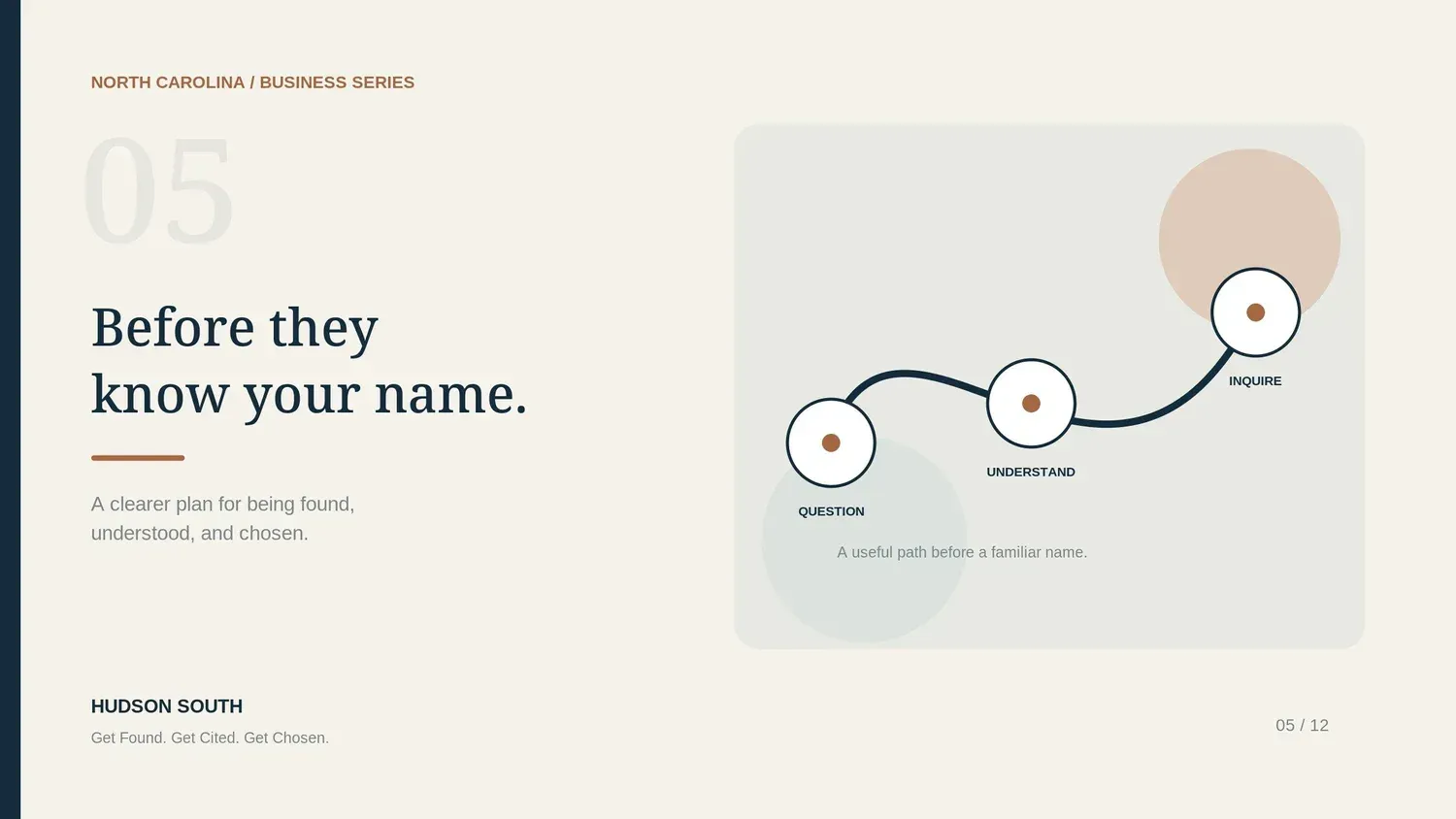
Content for an unfamiliar buyer should explain the problem, the available approaches, the business's fit, and the next step without assuming the reader already knows the brand. A North Carolina company can build that path with connected articles that help people move from a category question to a considered inquiry.
A referral arrives with an introduction. A search visitor often does not.
That difference can disappear inside a content plan. The website explains how long the business has operated and describes its commitment to customers. The blog reports company news. Both may be useful, but neither necessarily answers the question that brought an unfamiliar person to the category in the first place.
A buyer who has never heard of you needs more than a reason to like the brand. They need a way to decide whether the business belongs on their list.
Begin before the company name enters the conversation
Take a hypothetical homeowner who has recently moved to the Triangle. They are comparing approaches to a renovation and do not know the local providers. An article explaining how an early budget discussion differs from a detailed proposal could help them understand the purchase before they choose a contractor.
Now consider a hypothetical purchasing manager outside North Carolina looking for a supplier in the Triad. They know the part or production problem but not the companies that could address it. A supplier article explaining what information is needed to assess a project may be more useful than another general description of the region.
The point is not that either scenario represents a measured search trend. These are different starting conditions for planning content. One person needs to understand a service relationship. The other needs to assess a production fit.
Write down what the buyer already knows, what they still need to establish, and what would make an inquiry premature. That last question can reveal the most important article in the plan.
Build a connected path, not a pile of introductions
A useful reading path has a sequence of decisions. It does not need a separate post for every sentence a customer might type.
| Buyer stage | Triangle renovation example | Triad supplier example |
|---|---|---|
| Understand the category | How budgeting, a site visit, and an agreed project scope differ. | How to distinguish a process name from the capability needed for a specific part. |
| Assess fit | What the company needs to know before deciding whether the project is suitable. | Which approved materials, project types, and limits define the supplier's fit. |
| Compare approaches | Which differences in proposals deserve explanation rather than a price-only comparison. | What differences in quote assumptions and documentation need clarification. |
| Take the next step | What the first project conversation involves. | How to begin a quote discussion through an appropriate channel. |
The rows are a planning aid, not a requirement for four new articles. Some answers may belong together. Others may already exist and simply need clearer links.
Ask what decision remains after each piece. If the reader understands the subject but still cannot determine whether to contact the business, the next destination needs work.
Explain suitability before claiming superiority
“High quality” does not tell a buyer whether you accept their type of project. “Personal service” does not explain who handles the first conversation. “Full service” can conceal more than it reveals if the reader cannot identify the actual scope.
Replace broad assurances with the facts the business approves. Explain which situations it handles, what it needs to know, and where its responsibilities stop. That can include a boundary: a project size, a service area, a product type, or a condition that requires further assessment.
A clear boundary is not a failure to sell. It gives an unfamiliar buyer something concrete to evaluate. It also makes the content harder to reproduce through a generic prompt, because the answer comes from the company's own decisions.
For a manufacturer, the supplier-qualification article develops that work in detail. For appointment-based businesses, the first-visit content brief shows how the same principle changes when the next step is a consultation rather than a quote.
Make the article useful outside your website
Consider who could reasonably share or refer to the explanation. A trade organization may need a clear resource on preparing a supplier inquiry. A local business group may find an article about project-scoping questions useful. A customer may forward a comparison to a colleague or family member.
That is a distribution test: does the article remain useful when the promotional introduction is removed?
North Carolina manufacturers also have an existing discovery resource in Manufactured in North Carolina. Its public directory provides profiles of manufacturers and their capabilities. It is not an outreach list; the site explicitly prohibits using the directory for mass marketing. The relevant lesson is to make legitimate business descriptions consistent and helpful wherever buyers encounter them.
Do not promise a link, endorsement, or partnership merely because an organization seems relevant. Earn the right to be shared by making the resource useful and approaching appropriate contacts respectfully.
Do not confuse being mentioned with being chosen
A reference to the business in a search result or AI answer can be worth recording. It still does not show that the reader understood the offer, visited the site, or became a qualified prospect.
For this path, evaluate what happens after discovery. Which article did the person reach? Did they continue to an appropriate next step? What service did they ask about? Were they within the actual scope of the business?
Use the information your analytics and inquiry process can legitimately establish. An optional, plain-language “How did you hear about us?” question can add context, but it is not perfect attribution and should not be treated as such.
The distinction protects the content plan. A post that produces fewer but better-suited conversations may deserve continued investment. A post attracting people seeking something the company does not provide may need a different angle, even if its traffic looks impressive.
Commission the explanation the buyer needs first
Give the writer a customer situation, an unresolved decision, approved facts, and a next destination. Supply a real process owner for questions that cannot be answered from the brief. Do not ask the model to invent a customer journey from industry stereotypes.
The same planning method applies to software, logistics, education, nonprofits, consumer brands, and professional services. The facts and the buying decision will change. The need to understand an unfamiliar business will not disappear.
A strong article does not require the reader to trust your reputation before it becomes useful. It helps them begin forming a judgment through the quality of the explanation.
That is how a content plan can create an introduction where the business did not previously have one.
From the series: How North Carolina Businesses Can Compete in More Than One Market.
Create a path for people who do not know you yet
Discuss the questions, comparisons, and practical next steps that would help unfamiliar buyers understand your business.
Schedule a 30-minute conversation