
Website builds / Real estate and lending
Hudson Deed
Website builds for lenders, brokerages and property managers
Hudson South designs and builds websites for mortgage lenders, brokers, real estate brokerages and property managers on Netlify, WordPress, or Squarespace. Federal advertising rules reach parts of these sites that look like simple features, such as a payment calculator, a homepage rate, a stock photo or a footer license number, so each one is planned with the firm's compliance reviewer from the start.
Lending and real estate sites carry more regulated surface area than most business sites, and much of it hides in components rather than copy. A payment calculator, a rate banner, a listing template and a loan officer card are all design pieces, and each one can raise an advertising question.
This page covers fair housing and site imagery, Regulation Z on calculators and rate displays, NMLS identifiers, and how our build runs. Writing about programs and markets is covered on our real estate and lending content hub. Treat each point as an item for your compliance reviewer or counsel, not legal advice.
Fair housing reaches images and templates
HUD's regulation at 24 CFR 100.75 makes it unlawful to publish "any notice, statement or advertisement with respect to the sale or rental of a dwelling" that indicates a preference, limitation or discrimination on a protected basis. Its examples go beyond wording: one is "Using words, phrases, photographs, illustrations, symbols or forms which convey that dwellings are available" or unavailable to particular groups, and another is "Selecting media or locations for advertising" in ways that deny parts of the market information about housing. For a brokerage or property manager, that puts photography, listing templates and neighborhood pages inside the review. A neighborhood description is not a description of who should live there. Templates should describe the property and the place (housing types, commute routes, amenities the firm can verify), and the firm should approve every stock photo.
Calculators, rate displays and Regulation Z
Section 1026.24 of Regulation Z says an advertisement may state only terms that "actually are or will be arranged or offered by the creditor," requires a rate of finance charge to be stated as an "annual percentage rate," using that term, and lists terms that trigger further disclosure: the amount or percentage of any down payment, the number of payments or period of repayment, the amount of any payment, and the amount of any finance charge. Once a trigger term appears, the ad must also state the down payment, the terms of repayment and the annual percentage rate, and, if the rate may increase after consummation, that fact. For credit secured by a dwelling, the section also prohibits misleading use of the word "fixed."
A mortgage calculator that outputs a monthly payment displays the amount of a payment, one of those trigger terms, so ask compliance whether and how it should carry disclosures; the design should leave room for that text beside the number, not in a link below it. A homepage rate banner needs a named owner, a timestamp and the APR beside any rate. Ask your pricing lead, "When pricing changes at ten in the morning, who updates the rate on our homepage, and what does the page show if nobody does?" If nobody can answer, a rate-free design that invites a quote request may be the safer build.
NMLS identifiers and licensing details
The CFPB tells consumers that the Nationwide Mortgage Licensing System & Registry (NMLS) maintains a free service, NMLS Consumer Access, for checking whether a company or professional is authorized to conduct business in their state. For originators at covered financial institutions under 12 CFR part 1007, section 1007.105 requires the institution to make originators' unique identifiers available to consumers and requires each originator to provide the identifier upon request, before acting as an originator, and "through the originator's initial written communication with a consumer, if any, whether on paper or electronically." State-licensed lenders and brokers should ask each state regulator where their NMLS ID must appear. One layout to bring to compliance: the company ID in every footer, each loan officer's ID on that person's page with a link to NMLS Consumer Access, and a licensing page listing every state the compliance team confirms.
How the build runs
The work moves through our four steps. Authority Asset collects licenses and NMLS IDs, the programs actually offered, approved disclosure language, photo and listing rules, and application links. Nobody building a calculator should have to guess which disclosures the lender's compliance team requires, so those come in writing before design starts. Hudson Twenty-One records how loan officers and agents explain things, Market Intelligence maps what borrowers and owners ask, and AEO Creation turns those inputs into answer-first pages. The build adds JSON-LD, an XML sitemap, redirects, mobile and automated accessibility checks, and a quality gate on copy. Applications should link to the firm's own systems: the FTC Safeguards Rule lists "mortgage lenders" and "mortgage brokers" among covered institutions, and a contact form that emails submissions is no place for a Social Security number. Netlify suits low upkeep with us making edits, WordPress suits posting market updates yourself, and Squarespace suits a simple editor you manage.
Recent builds
From a recent build
Captured on desktop and phone. On most of them, business names, logos, people and phone numbers are blurred.
-
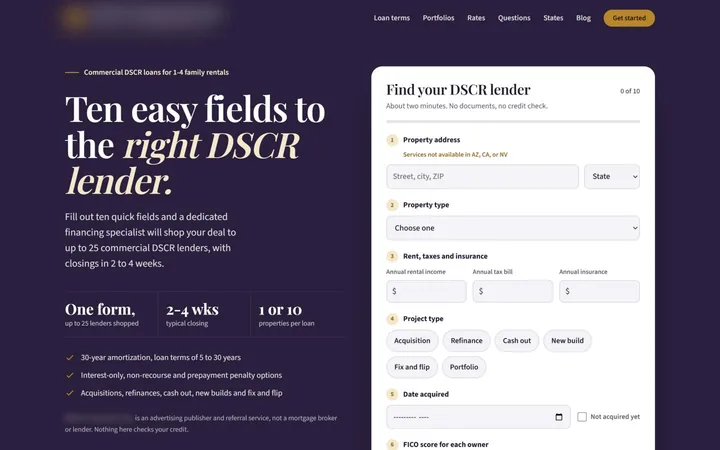
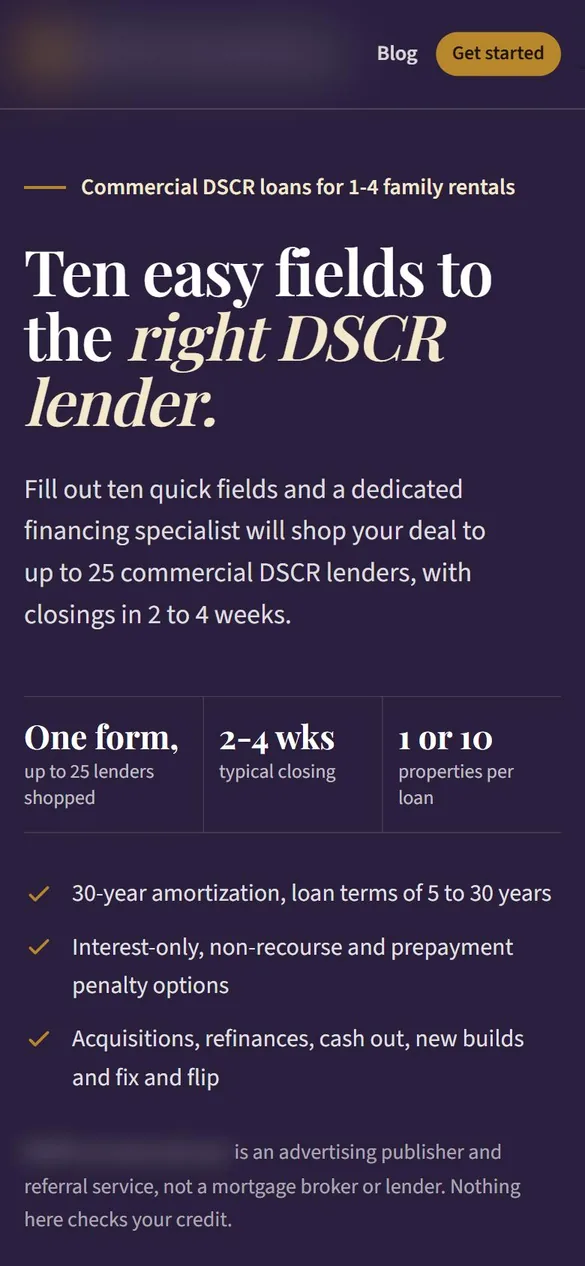
Live siteInvestment property lending, lead generationA ten-field lender-matching form fills the first screen, and the referral disclosure is in view before anyone starts typing.
By industry
Other industries
Law firms
Hudson South designs and builds law firm websites on Netlify, WordPress, or Squarespace, with practice area pages, attorney bios, and an intake path planned around how the firm takes on matters.
Home services and trades
Hudson South designs and builds websites for HVAC, roofing, plumbing, electrical, remodeling and foundation companies on Netlify, WordPress, or Squarespace.
Medical, dental and wellness
Hudson South designs and builds websites for medical, dental, physical therapy, chiropractic and med spa practices on Netlify, WordPress, or Squarespace.
Financial, accounting and tax
Hudson South designs and builds websites for financial advisors, CPA firms, tax practices and bookkeepers on Netlify, WordPress, or Squarespace.
Manufacturing and industrial
Hudson South designs and builds websites for manufacturers, contract manufacturers and industrial suppliers on Netlify, WordPress, or Squarespace.
Questions we answer
Questions to settle before you build
The ownership, rules and search questions that apply to every industry's website.
Owning your website
- Do you own your website, or are you renting it?
You own your website if your business holds the domain, the hosting account, the site files and the written content, and the contract keeps them with you when the relationship ends.
Built for search and AI
- What makes a website easy for AI assistants to read and quote?
A website is easier for AI assistants to read and quote when its important answers are in plain HTML text, its pages can be reached and indexed, its links are real links, and each answer still makes sense lifted out on its own.
- What is structured data, and does your website need it?
Structured data is code on a page, usually JSON-LD, that labels facts the page already states, such as the business name, address, phone number and hours.
- How fast should a website load, and what slows it down?
Google's published targets are that the main content appears within 2.5 seconds, the page responds to a tap or click in under 200 milliseconds, and layout shift stays below 0.1, measured at the 75th percentile of real visits.
- Does a business website need a blog?
Not always.
- How should a website's URLs and page hierarchy be organized?
Use short, readable URLs made of words and hyphens in one consistent case, inside folders that group related pages the way buyers expect.
Rules and requirements
- Does a business website need to meet accessibility standards?
Most businesses that serve the public should plan their website with accessibility built in.
- What does a website need when it collects contact information?
A website that collects contact details needs a form that asks only for what the business uses, a privacy policy that matches what really happens to submissions, a secure connection, and a retention plan.
Questions
Common questions
Can we put a mortgage calculator on our website?
Yes, with compliance involved from the design stage, since a monthly payment is one of Regulation Z's trigger terms.
Do fair housing rules apply to the photos on our website?
Yes. HUD's advertising regulation names photographs and illustrations alongside words, so photos get the same review as listing copy.
Should our homepage show today's rate?
Only if someone owns updating it and the APR appears beside it. If the rate cannot be kept current, a quote request avoids publishing a stale number.
Sources
- 24 CFR 100.75 Discriminatory advertisements, statements and notices. Electronic Code of Federal Regulations. Read 2026-10-17.
- 12 CFR 1026.24 Advertising. Consumer Financial Protection Bureau. Read 2026-10-17.
- 12 CFR 1007.105 Use of unique identifier. Electronic Code of Federal Regulations. Read 2026-10-17.
- Is there any way I can check to see if the company or person I contact is permitted to make or broker mortgage loans?. Consumer Financial Protection Bureau. Read 2026-10-17.
- FTC Safeguards Rule: What Your Business Needs to Know. Federal Trade Commission. Read 2026-10-17.
Hudson Deed
Start with a look at your market.
We compare your site with your competitors' and walk you through what we find on a free 30-minute call. Every Hudson Deed site is yours to keep, from the domain to the copy.