
Website builds / Law firms
Hudson Deed
Website builds for law firms
Hudson South designs and builds law firm websites on Netlify, WordPress, or Squarespace, with practice area pages, attorney bios, and an intake path planned around how the firm takes on matters. A firm's website is a communication about its lawyers' services, so its state's advertising rules shape what the pages say and show.
A law firm website answers to two audiences. One is a person with a legal problem, often on a phone, deciding whether this firm handles matters like theirs. The other is the professional conduct rules in the firm's state, which govern what the site may claim.
This page covers the website itself: the page set, where advertising rules show up in the design, intake and accessibility, and how a Hudson South build runs for a firm. The writing that fills those pages has its own home on our law firm content hub.
The page set a firm site usually needs
- Home page: who the firm represents, in which matters, and where, up front.
- One page per practice area: each matter type gets its own URL, its own structured data, and room for its own questions.
- Attorney bios: one page per lawyer, with the matters that lawyer handles, bar admissions, and a direct route to intake.
- Intake page: what happens after someone calls or submits the form.
- Contact and privacy pages: consistent addresses and phone numbers, and what the forms collect.
Fee and results pages are optional, and each is a decision for the partners rather than a template default. Before the sitemap is final, one partner might ask the group, "If a reader lands on our probate page from a search, can they reach the right attorney and the intake form without hunting?" Our note on organizing URLs and page hierarchy covers how those addresses nest.
Where advertising rules show up in the design
Attorney advertising is regulated state by state. The American Bar Association says its Model Rules "serve as models for the ethics rules of most jurisdictions," but the version that binds a firm is its own state's, read by its attorneys or ethics counsel.
Model Rule 7.2(d) requires a communication about a lawyer's services to include "the name and contact information" of at least one lawyer or firm responsible for its content, which on a website usually becomes a footer on every page. Rule 7.2(c) bars stating or implying certification as a specialist unless stated conditions are met, including that the certifying organization is "clearly identified" in the communication, so whether a bio page labels that field "Practice areas" or "Specialties" is a wording call for the firm's reviewer, not the designer.
Rule 7.1 treats a statement as misleading when it "omits a fact necessary to make the statement considered as a whole not materially misleading." Design can create that problem without a false word: a rotating banner of settlement figures, stripped of their facts, is a layout decision. If a firm chooses to show results, the template should give each one room for its context, and disclaimers belong where the firm's reviewer says the state's rules call for them. A footer disclaimer is not a substitute for a page that reads accurately on its own.
Intake, forms and accessibility
A short intake form usually serves best: contact details, the general type of matter, and the names conflict checking needs. What the form says about confidentiality, and whether it asks people to hold back case details for now, is wording the firm's ethics counsel should supply. Submissions are emailed to the firm, and the intake page should say who responds and what happens next.
The Justice Department's Title III regulations name the "office of an accountant or lawyer" among places of public accommodation, and its web guidance states the Department's position that the ADA's requirements apply to all the goods, services, privileges, or activities such businesses offer. It lists inaccessible online forms among common barriers and points to WCAG as helpful guidance. Every build gets automated accessibility checks, which catch some problems, miss others, and are not a legal opinion.
How a firm build runs
The build follows our four steps. Authority Asset gathers the practice areas the firm takes, the matters it declines, each lawyer's admissions, office details, and any results cleared for publication. A designer should not have to guess which cases a firm turns away, so those facts arrive in writing before drafting. Hudson Twenty-One records how the lead attorney explains things, Market Intelligence researches the questions local clients ask about each practice area, and AEO Creation turns those inputs into answer-first pages. The build adds JSON-LD for the firm and its attorneys, an XML sitemap, redirects from old URLs, mobile layout checks and a quality gate on copy, and nothing should launch until the firm's reviewer has read it.
On platform: Netlify for a firm that wants speed, security and low upkeep with us making edits, WordPress for one that wants to log in and post its own blog, and Squarespace for one that wants a simple editor it manages itself.
Recent builds
From our recent builds
Captured on desktop and phone. On most of them, business names, logos, people and phone numbers are blurred.
-
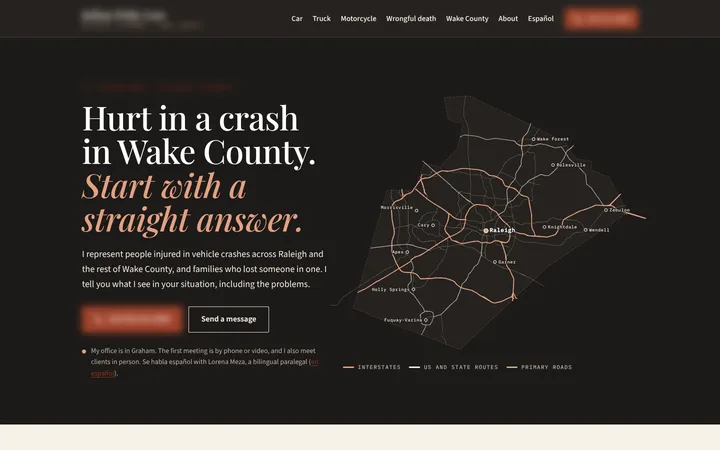

Live sitePersonal injury firm, Raleigh and Wake County, North CarolinaThe site opens on a map drawn from Wake County's real road network, with town pages for six Wake County towns and a Spanish section for Spanish-speaking callers. -
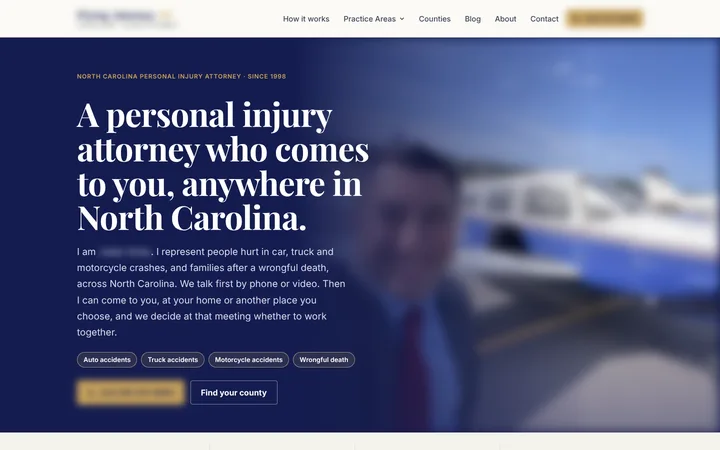
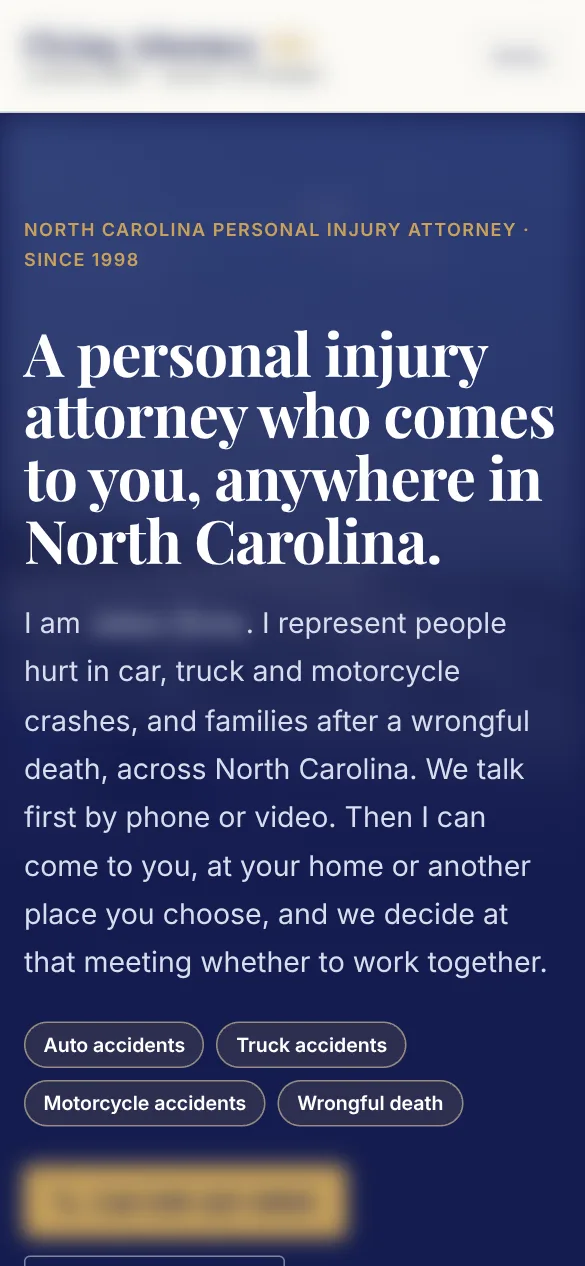
Live sitePersonal injury attorney who travels to clients, statewide North CarolinaThe first screen says the attorney comes to you anywhere in the state, the first talk is by phone or video, and a county finder sits beside the call button. -
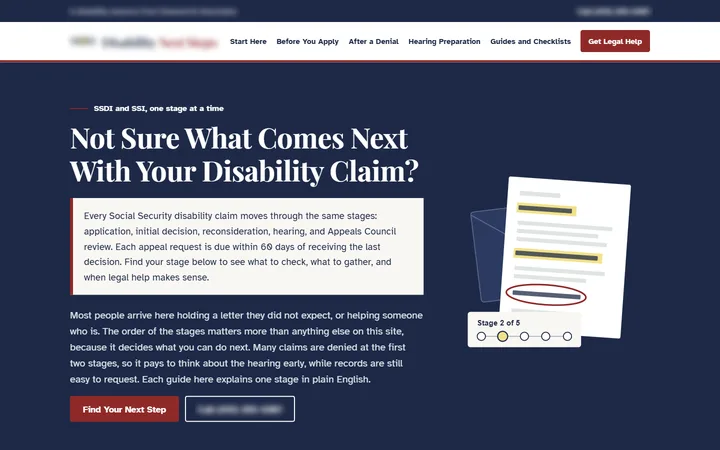
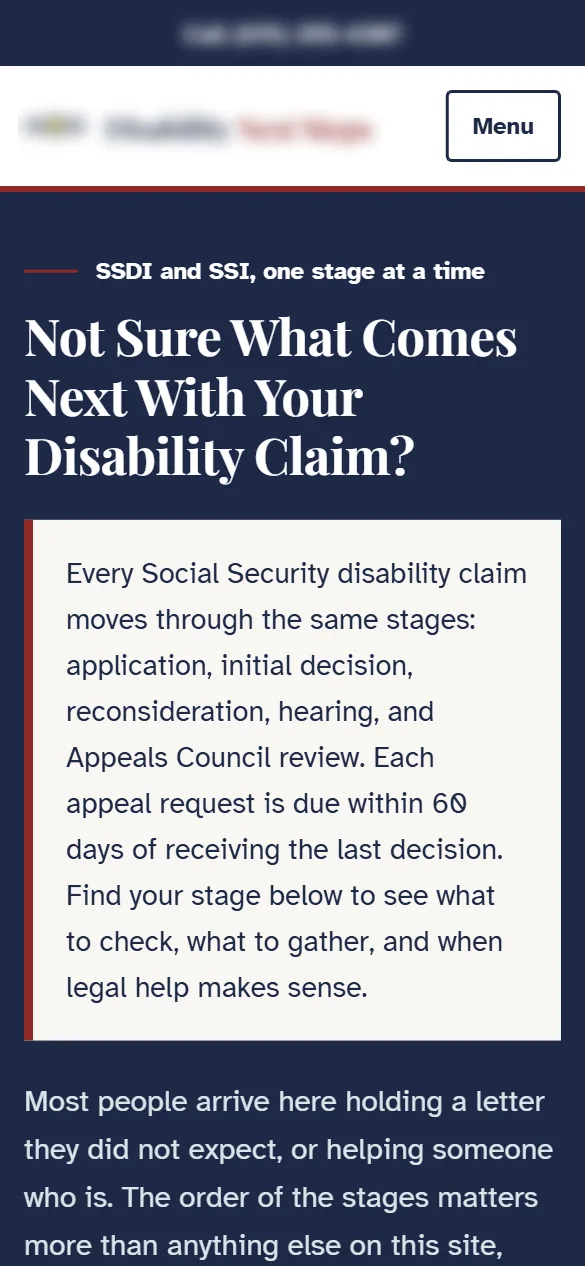
Site in reviewSocial Security disability law firm, nationwideA second site built to teach before it asks for anything: visitors start from the letter in their hand, each of the five claim stages is explained with the federal rule behind it, and four printable worksheets keep what people write off the site. -
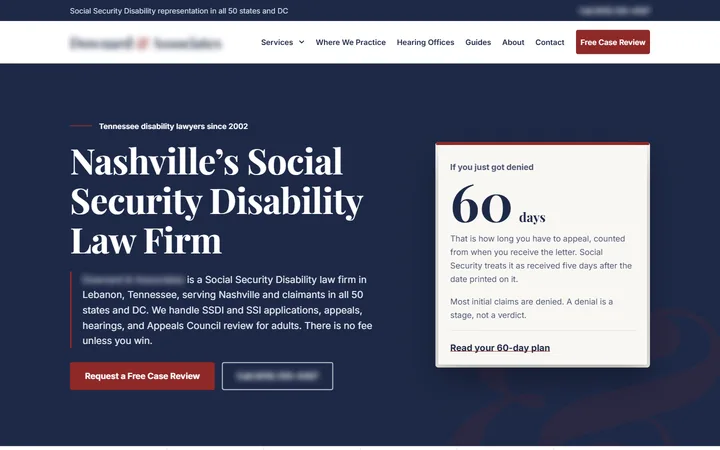
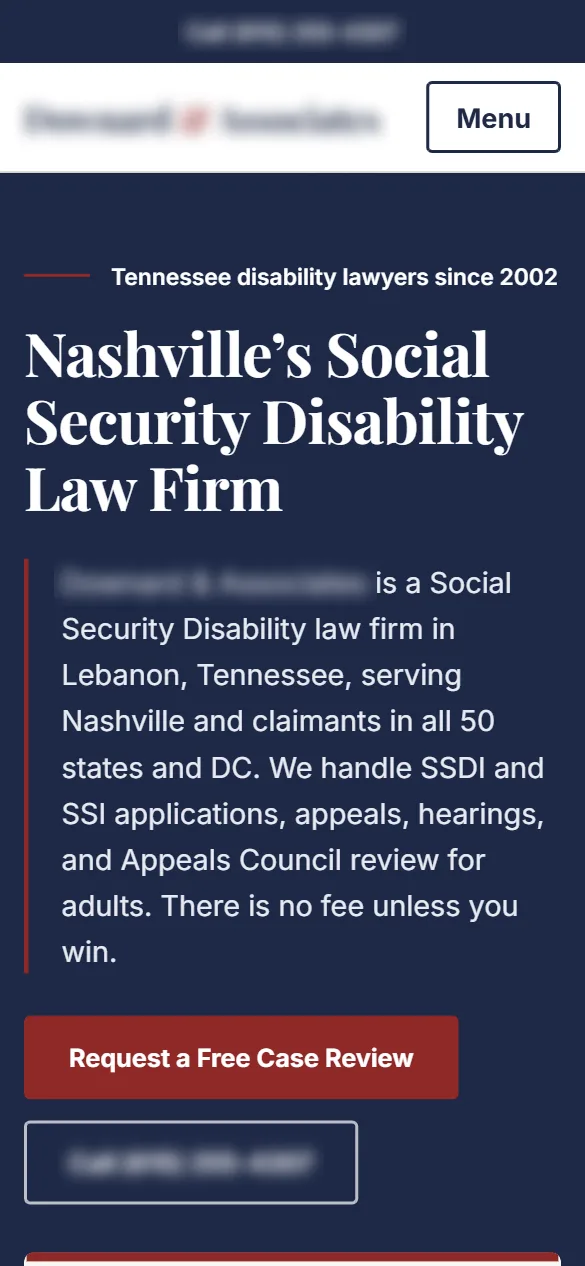
Homepage conceptSocial Security disability law firm, Nashville and all 50 statesSomeone who was just denied sees the 60-day appeal clock on the first screen, the federal fee cap sits in the stats right below it, and a clickable map covers every state the firm serves. -
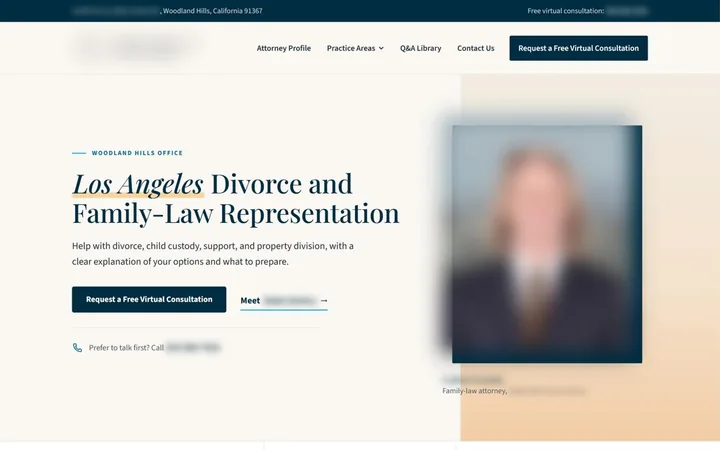
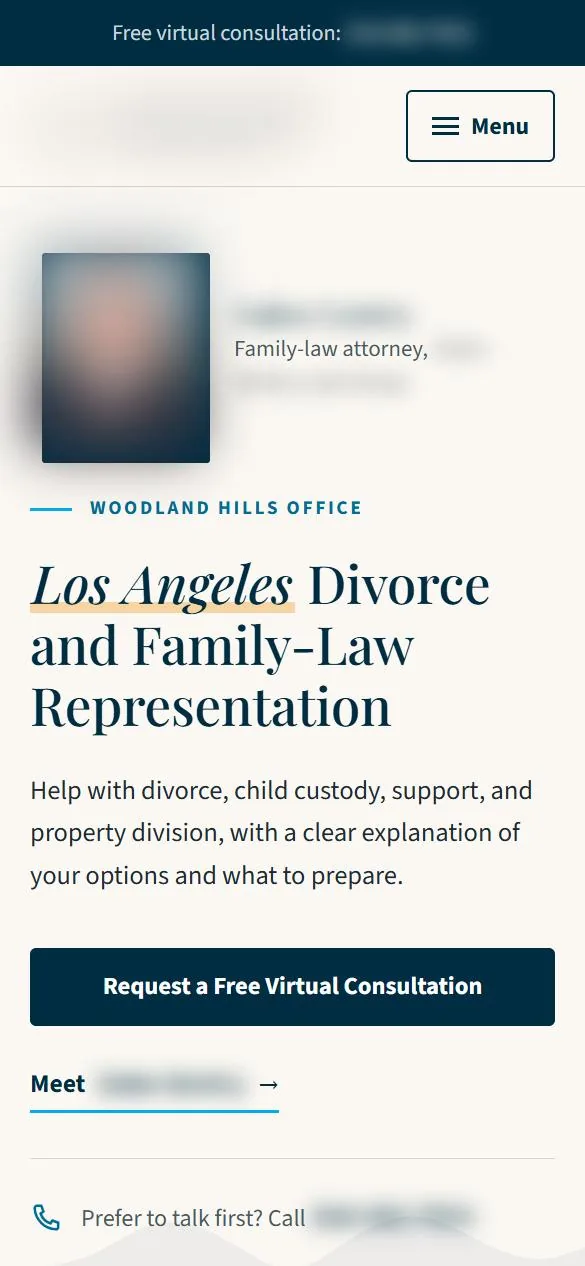
Homepage conceptFamily law firm, Los Angeles areaPractice areas and a Q&A library sit in the main menu, and a virtual consultation request is the first button on the page. -
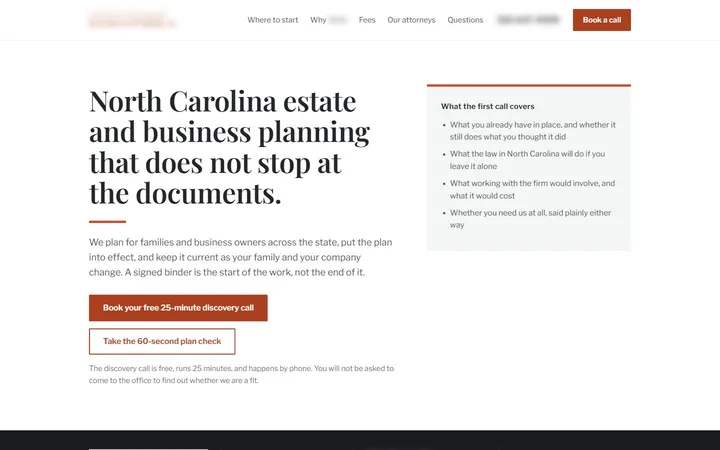
Homepage conceptEstate and business planning firm, North CarolinaThe first screen spells out what the free first call covers, with a 60-second plan check as a second way in.
By industry
Other industries
Home services and trades
Hudson South designs and builds websites for HVAC, roofing, plumbing, electrical, remodeling and foundation companies on Netlify, WordPress, or Squarespace.
Medical, dental and wellness
Hudson South designs and builds websites for medical, dental, physical therapy, chiropractic and med spa practices on Netlify, WordPress, or Squarespace.
Financial, accounting and tax
Hudson South designs and builds websites for financial advisors, CPA firms, tax practices and bookkeepers on Netlify, WordPress, or Squarespace.
Real estate and lending
Hudson South designs and builds websites for mortgage lenders, brokers, real estate brokerages and property managers on Netlify, WordPress, or Squarespace.
Manufacturing and industrial
Hudson South designs and builds websites for manufacturers, contract manufacturers and industrial suppliers on Netlify, WordPress, or Squarespace.
Questions we answer
Questions to settle before you build
The ownership, rules and search questions that apply to every industry's website.
Owning your website
- Do you own your website, or are you renting it?
You own your website if your business holds the domain, the hosting account, the site files and the written content, and the contract keeps them with you when the relationship ends.
- What happens to your website when you cancel a marketing contract?
It depends on what the contract says and whose name is on each account.
Built for search and AI
- What makes a website easy for AI assistants to read and quote?
A website is easier for AI assistants to read and quote when its important answers are in plain HTML text, its pages can be reached and indexed, its links are real links, and each answer still makes sense lifted out on its own.
- What is structured data, and does your website need it?
Structured data is code on a page, usually JSON-LD, that labels facts the page already states, such as the business name, address, phone number and hours.
- How fast should a website load, and what slows it down?
Google's published targets are that the main content appears within 2.5 seconds, the page responds to a tap or click in under 200 milliseconds, and layout shift stays below 0.1, measured at the 75th percentile of real visits.
- Does a business website need a blog?
Not always.
Rules and requirements
- Does a business website need to meet accessibility standards?
Most businesses that serve the public should plan their website with accessibility built in.
- What does a website need when it collects contact information?
A website that collects contact details needs a form that asks only for what the business uses, a privacy policy that matches what really happens to submissions, a secure connection, and a retention plan.
Questions
Common questions
Who writes the disclaimers our website needs?
The firm's attorneys or ethics counsel. Which disclaimers a page needs depends on the firm's state rules, so the template should give them a consistent place and the reviewer should supply the wording.
Can our new site display case results?
It can, if the partners decide to publish them and their reviewer clears each one. A results template should carry the context behind each figure, so a number never appears alone on a banner.
Does every attorney need a separate bio page?
Usually. A separate page gives intake staff a link to send a caller and carries that lawyer's admissions, matters and structured data.
Sources
- Model Rules of Professional Conduct. American Bar Association. Read 2026-10-17.
- Rule 7.1: Communications Concerning a Lawyer's Services. American Bar Association. Read 2026-10-17.
- Rule 7.2: Communications Concerning a Lawyer's Services: Specific Rules. American Bar Association. Read 2026-10-17.
- 28 CFR 36.104 Definitions. Electronic Code of Federal Regulations. Read 2026-10-17.
- Guidance on Web Accessibility and the ADA. U.S. Department of Justice, ADA.gov. Read 2026-10-17.
Hudson Deed
Start with a look at your market.
We compare your site with your competitors' and walk you through what we find on a free 30-minute call. Every Hudson Deed site is yours to keep, from the domain to the copy.