
Website builds / Financial, accounting and tax
Hudson Deed
Website builds for financial, accounting and tax firms
Hudson South designs and builds websites for financial advisors, CPA firms, tax practices and bookkeepers on Netlify, WordPress, or Squarespace. The kind of firm decides which rules shape the site, so the build plan should map requirements to pages and give clients a secure route for documents outside any ordinary contact form.
An SEC-registered adviser, a state-registered adviser, an enrolled agent and a bookkeeper may offer overlapping services, yet each answers to a different mix of rules about what a page may show, what must be posted, and how client documents travel.
This page covers which rule touches which part of the site, portal links and secure upload, and the pages a build carries. Writing about fees is on our financial firms content hub. Everything below is a planning map for your compliance officer or counsel, not legal advice.
Which rule touches which part of the site
| Type of firm | Rule | Where it shows up on the site |
|---|---|---|
| Adviser registered, or required to be registered, with the SEC | SEC Marketing Rule, Rule 206(4)-1 | Service pages, testimonials, ratings, performance figures |
| SEC-registered adviser or broker-dealer serving retail investors | Form CRS requirements | Relationship summary posted prominently |
| SEC-registered adviser or broker-dealer | Regulation S-P | Safeguards for customer information sent through the site or portal |
| Practitioners before the IRS, including attorneys, CPAs and enrolled agents | Circular 230, section 10.30 | Statements about services, published fee schedules |
| Tax preparation firms; advisers not required to register with the SEC | FTC Safeguards Rule | Encryption and access controls for uploads |
The SEC's compliance guide says the first part of the Marketing Rule's advertisement definition covers communications offering "the investment adviser's investment advisory services with regard to securities to prospective clients," and "does not include one-on-one communications," with exceptions for hypothetical performance. A public services page reads a lot like that, so the chief compliance officer decides which pages count. The decision shapes design: a review widget needs room for disclosures on whether the person is a client and was compensated, and a performance display must be able to show net results beside gross and, in most cases, cover specific time periods. The rule's text reaches advisers registered or required to be registered with the SEC, so a state-registered adviser should ask its state securities regulator which rules apply.
The SEC's Form CRS guide is direct: "You must post the current version of the relationship summary prominently on your public website, if you have one." Circular 230 section 10.30 bars "a misleading or deceptive statement or claim" in public communication and says a practitioner who publishes a fee schedule may charge no more than the published rates "for at least 30 calendar days after the last date on which the schedule of fees was published." A fee page stays published for as long as it is live, so ask counsel when that clock starts after a rate changes; a visible effective date, with earlier versions kept on file, makes the answer easy to document.
Client portals and secure document upload
Clients often look to the website for a way to send documents. A contact form is not a document vault. Our builds email form submissions to the business, which works for a name and phone number and is the wrong channel for a W-2, so the form should say not to attach financial documents and should link to the firm's secure portal.
The rules behind that differ by firm. The FTC Safeguards Rule lists "tax preparation firms" and "investment advisors that aren't required to register with the SEC" among covered institutions, and the FTC's summary calls for encrypting customer information on the firm's system and in transit and for multi-factor authentication. SEC-registered advisers and broker-dealers fall under Regulation S-P instead, which requires written policies that "address administrative, technical, and physical safeguards for the protection of customer information" and an incident response program. The website's part is to send people there, never to open a weaker channel.
Pages the build carries and how it runs
Most firms need a page per service, a bio for each professional that explains every designation in plain words, a fee or engagement page, a getting-started page, portal links, and a footer holding the disclosures the compliance officer specifies, including the Form CRS link where it applies. As a launch check, ask the office manager, "If a client sent us a tax return through the website tomorrow, where would it land, and who could open it?" Authority Asset gathers registration status, approved disclosure language, dated fee schedules and portal links, because our designers should not have to guess whether a firm is SEC- or state-registered. Hudson Twenty-One records how the partners explain things, Market Intelligence researches what prospects ask, and AEO Creation turns those inputs into answer-first pages. The build adds JSON-LD, an XML sitemap, redirects, mobile and automated accessibility checks, and a quality gate on copy, and the firm's reviewer should approve each page before it goes live. WordPress fits a firm that wants to publish its own commentary, Netlify one that wants low upkeep with edits handled by us, and Squarespace one that wants a simple editor of its own.
Recent builds
From our recent builds
Captured on desktop and phone. On most of them, business names, logos, people and phone numbers are blurred.
-
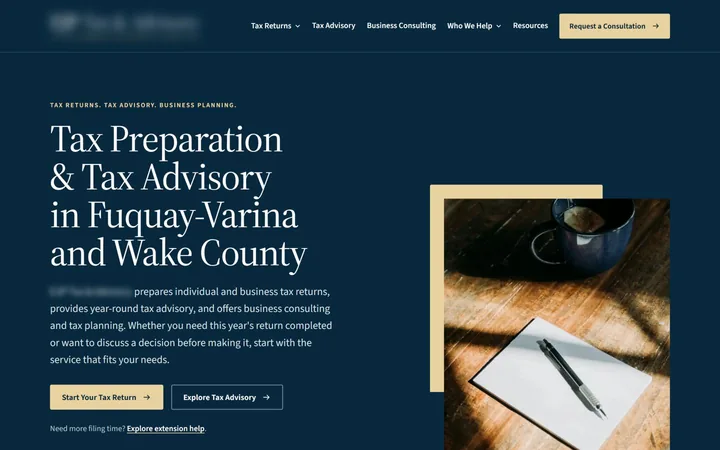
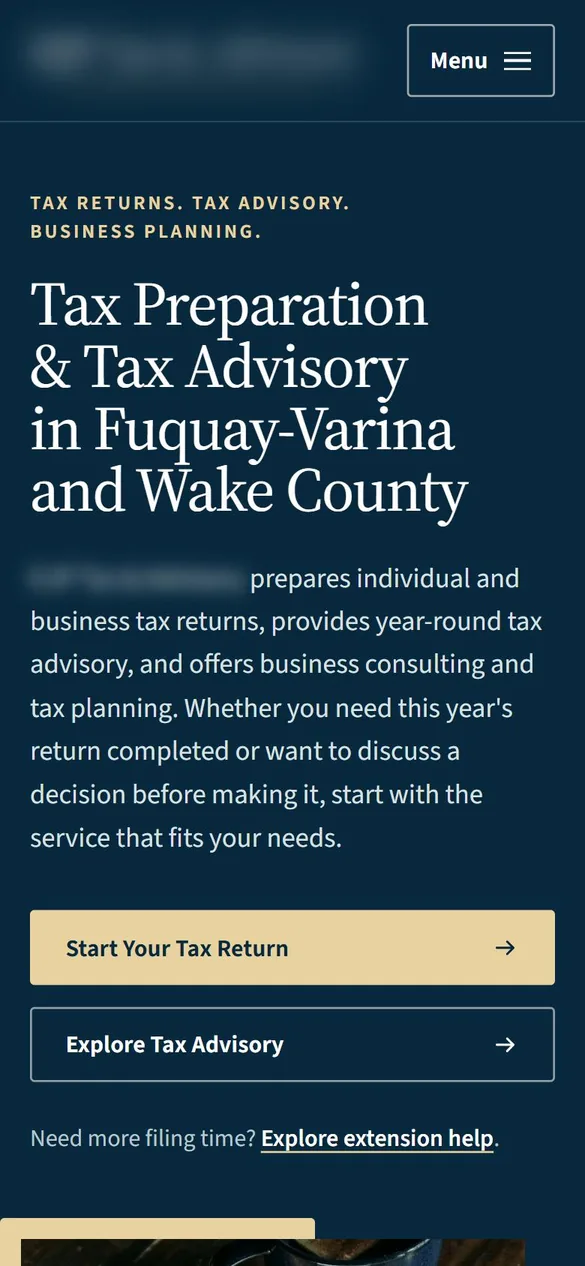
Site in reviewTax practice, Fuquay-Varina and Wake County, North CarolinaThe first screen splits visitors two ways, filing a return or year-round tax advisory, with extension help one click from the top. -
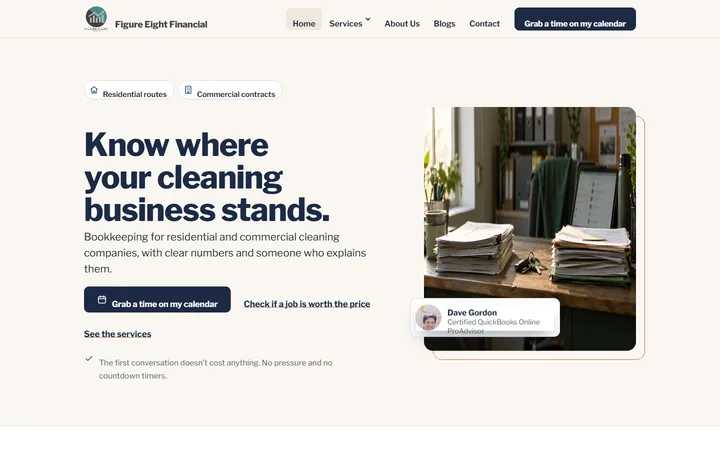
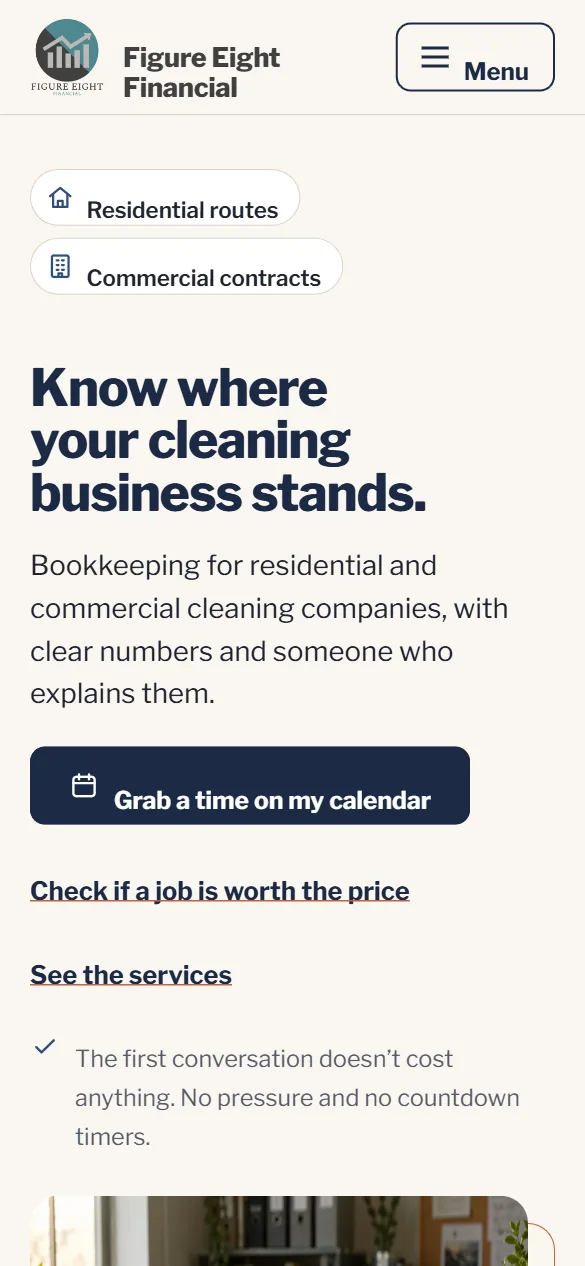
Live siteFigure Eight Financial, bookkeeping for cleaning companiesWritten for one niche, residential and commercial cleaning companies, with booking a call as the main action and a quick check of whether a job is worth the price.
By industry
Other industries
Law firms
Hudson South designs and builds law firm websites on Netlify, WordPress, or Squarespace, with practice area pages, attorney bios, and an intake path planned around how the firm takes on matters.
Home services and trades
Hudson South designs and builds websites for HVAC, roofing, plumbing, electrical, remodeling and foundation companies on Netlify, WordPress, or Squarespace.
Medical, dental and wellness
Hudson South designs and builds websites for medical, dental, physical therapy, chiropractic and med spa practices on Netlify, WordPress, or Squarespace.
Real estate and lending
Hudson South designs and builds websites for mortgage lenders, brokers, real estate brokerages and property managers on Netlify, WordPress, or Squarespace.
Manufacturing and industrial
Hudson South designs and builds websites for manufacturers, contract manufacturers and industrial suppliers on Netlify, WordPress, or Squarespace.
Questions we answer
Questions to settle before you build
The ownership, rules and search questions that apply to every industry's website.
Owning your website
- Do you own your website, or are you renting it?
You own your website if your business holds the domain, the hosting account, the site files and the written content, and the contract keeps them with you when the relationship ends.
Built for search and AI
- What makes a website easy for AI assistants to read and quote?
A website is easier for AI assistants to read and quote when its important answers are in plain HTML text, its pages can be reached and indexed, its links are real links, and each answer still makes sense lifted out on its own.
- What is structured data, and does your website need it?
Structured data is code on a page, usually JSON-LD, that labels facts the page already states, such as the business name, address, phone number and hours.
- How fast should a website load, and what slows it down?
Google's published targets are that the main content appears within 2.5 seconds, the page responds to a tap or click in under 200 milliseconds, and layout shift stays below 0.1, measured at the 75th percentile of real visits.
- Does a business website need a blog?
Not always.
- How should a website's URLs and page hierarchy be organized?
Use short, readable URLs made of words and hyphens in one consistent case, inside folders that group related pages the way buyers expect.
Rules and requirements
- Does a business website need to meet accessibility standards?
Most businesses that serve the public should plan their website with accessibility built in.
- What does a website need when it collects contact information?
A website that collects contact details needs a form that asks only for what the business uses, a privacy policy that matches what really happens to submissions, a secure connection, and a retention plan.
Questions
Common questions
Is our website an advertisement under the SEC Marketing Rule?
Parts of it may be, if your firm is registered or required to be registered with the SEC. Your chief compliance officer decides which pages fall inside the rule's definition.
Can clients upload tax documents through our website?
Not through an ordinary contact form. Uploads belong in a secure portal covered by the firm's information security program, and the site should link there.
We are an enrolled agent. Does publishing our fees create an obligation?
Yes. Under Circular 230 section 10.30, you may charge no more than published rates for at least 30 calendar days after the last date the schedule was published, so date the fee page and keep earlier versions.
Sources
- Investment Adviser Marketing. U.S. Securities and Exchange Commission. Read 2026-10-17.
- Form CRS Relationship Summary; Amendments to Form ADV. U.S. Securities and Exchange Commission. Read 2026-10-17.
- 17 CFR 248.30 Procedures to safeguard customer information. Electronic Code of Federal Regulations. Read 2026-10-17.
- 31 CFR 10.30 Solicitation. Electronic Code of Federal Regulations. Read 2026-10-17.
- 31 CFR 10.3 Who may practice. Electronic Code of Federal Regulations. Read 2026-10-17.
- FTC Safeguards Rule: What Your Business Needs to Know. Federal Trade Commission. Read 2026-10-17.
Hudson Deed
Start with a look at your market.
We compare your site with your competitors' and walk you through what we find on a free 30-minute call. Every Hudson Deed site is yours to keep, from the domain to the copy.