
Website builds / Home services and trades
Hudson Deed
Website builds for home service companies
Hudson South designs and builds websites for HVAC, roofing, plumbing, electrical, remodeling and foundation companies on Netlify, WordPress, or Squarespace. A trade site has to give an urgent caller a one-tap path to a person, give a planned project a clear quote request, and lay out service areas honestly instead of cloning a page for every town.
People reach a trade company's website in two very different states. Someone with a failed furnace in January wants a phone number and an answer about tonight. Someone planning a roof replacement next spring wants to understand the process and request a quote without a sales call. One site has to serve both.
This page covers the website side: how service areas are structured, emergency contact paths, where license details belong, and how quote requests flow. Topics and copy for trade companies are covered on our home services content hub.
Service areas without city swaps
The usual shortcut is a page for every town in the service area, identical except for the name. Google's spam policies describe doorway abuse as sites or pages "created to rank for specific, similar search queries," and one listed example reads: "Creating substantially similar pages that are closer to search results than a clearly defined, browseable hierarchy." A better structure is one service area page listing the towns and counties covered, plus a separate location page only where the company has something true to say about that place, such as an office, a crew based there, or local permit work it handles often. A list of towns is not a location page.
The website and the Google Business Profile should describe the same area. Google's guidelines tell service-area businesses, "you should hide your business address from customers," and say the overall service area "shouldn't extend farther than about 2 hours of driving time" from the base, while allowing larger areas for some businesses. Our note on URL and page hierarchy covers how location pages nest under services.
Emergency contact paths
On a phone, the emergency path should take one tap: a tap-to-call number fixed in the mobile header, and an emergency page that says which problems count as emergencies, when someone answers, and any after-hours charge, all supplied by the company. A useful test before launch is to have the owner ask the dispatcher, "When someone calls the number on our emergency page at two in the morning, who picks up, and what do they say?" If the honest answer is a voicemail, the page should say so.
Google's guidelines ask for "a phone number that connects to your individual business location," prefer a local number over a central call center line where possible, and ask for "regular customer-facing hours of operation." In structured data, Google's local business documentation says a business open around the clock sets its hours to open at "00:00" and close at "23:59." A company should be marked as open 24 hours only when a person actually answers 24 hours.
License details and trust information
The FTC's advice to homeowners after weather disasters is direct: "Check with your state or county government to confirm a contractor's license." A site makes that check easy by showing each license number with its issuing agency, in the footer and on a page covering licensing, insurance and warranty terms. Ask your state licensing board whether its rules require the number in advertising and how that applies to a website. The same FTC advice tells homeowners to ask for proof of insurance and a written contract, so the site should say how the company provides both.
Quote requests and how the build runs
A quote form should collect what the estimator needs to call back prepared: the type of work, an address or ZIP code to confirm the service area, a short description, preferred contact times, and an optional photo upload. The confirmation screen should say what happens next, and the form should state that it is not for emergencies, with the phone number beside it. Every submission is emailed to the business.
The build follows our four steps. Authority Asset collects license and insurance documents, warranty terms, the jobs the company takes and refers out, and its emergency policy. Whoever designs the quote form should not have to guess which jobs the company turns down, so that list is written and approved first. Hudson Twenty-One records how the owner explains repairs, Market Intelligence researches what homeowners ask about each service and town, and AEO Creation turns those inputs into answer-first pages. The build adds JSON-LD, an XML sitemap, redirects from old URLs, mobile layout checks, automated accessibility checks, and a quality gate on copy. A company that wants staff to post seasonal updates fits WordPress, one that would rather send changes to us fits Netlify, and one that wants a simple editor of its own fits Squarespace.
Recent builds
From our recent builds
Captured on desktop and phone. On most of them, business names, logos, people and phone numbers are blurred.
-
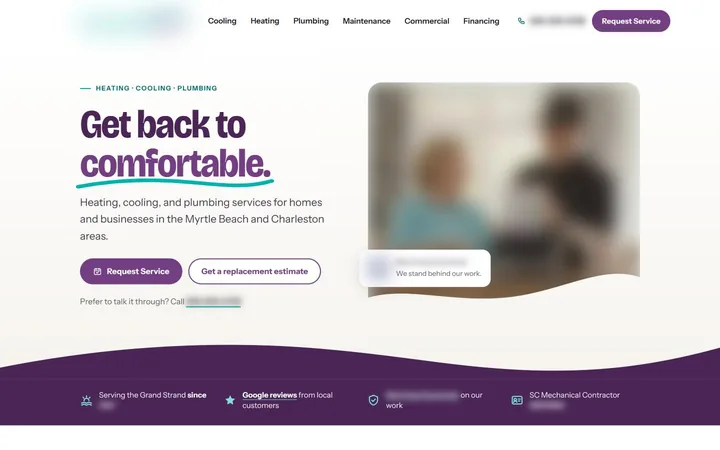
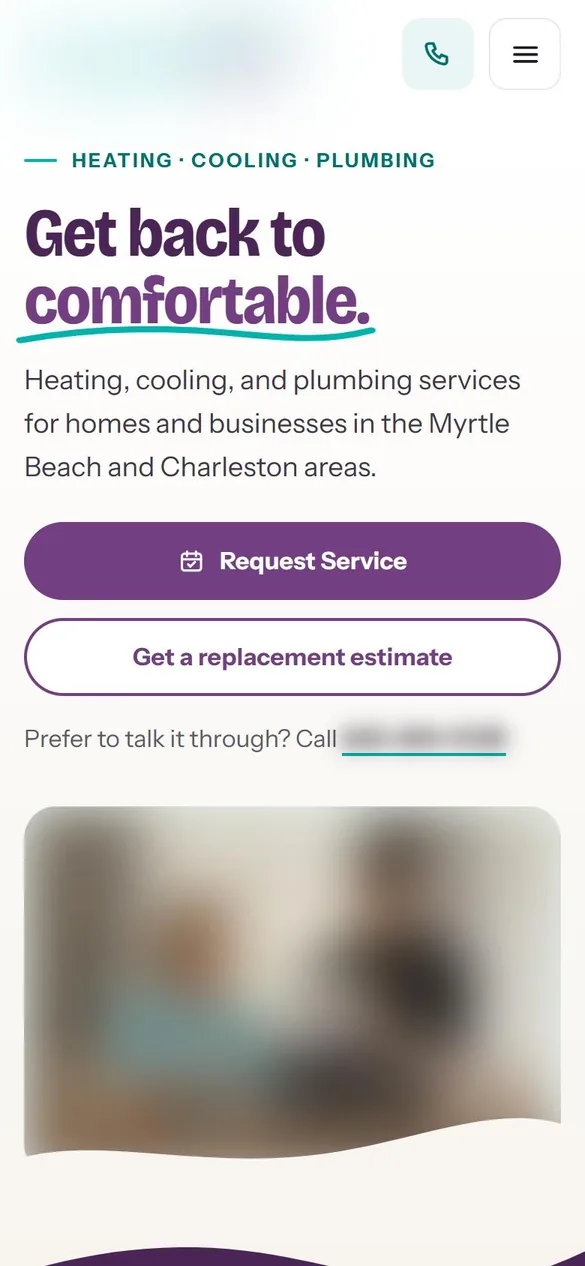
Homepage conceptHeating, cooling and plumbing company, South Carolina coastThe menu is organized by trade, a request-service button stays in the header, and the opening line names the service area. -
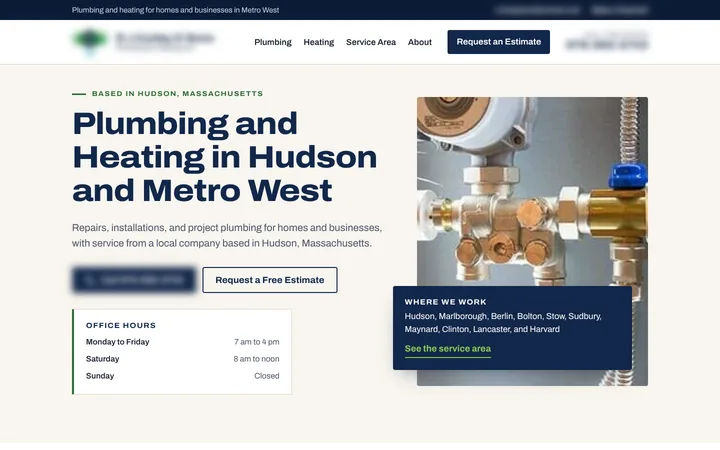
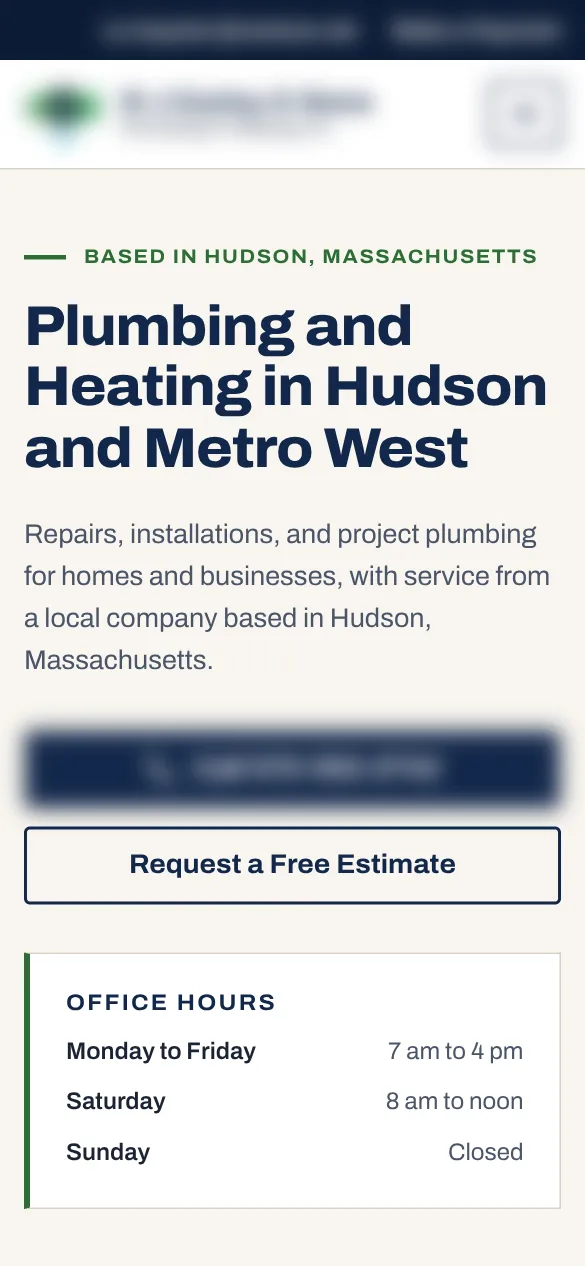
Homepage conceptPlumbing and heating company, Hudson and MetroWest, MassachusettsThe opening line names the service area, the call button and the free estimate request sit side by side, and office hours sit right under them.
By industry
Other industries
Law firms
Hudson South designs and builds law firm websites on Netlify, WordPress, or Squarespace, with practice area pages, attorney bios, and an intake path planned around how the firm takes on matters.
Medical, dental and wellness
Hudson South designs and builds websites for medical, dental, physical therapy, chiropractic and med spa practices on Netlify, WordPress, or Squarespace.
Financial, accounting and tax
Hudson South designs and builds websites for financial advisors, CPA firms, tax practices and bookkeepers on Netlify, WordPress, or Squarespace.
Real estate and lending
Hudson South designs and builds websites for mortgage lenders, brokers, real estate brokerages and property managers on Netlify, WordPress, or Squarespace.
Manufacturing and industrial
Hudson South designs and builds websites for manufacturers, contract manufacturers and industrial suppliers on Netlify, WordPress, or Squarespace.
Questions we answer
Questions to settle before you build
The ownership, rules and search questions that apply to every industry's website.
Owning your website
- Do you own your website, or are you renting it?
You own your website if your business holds the domain, the hosting account, the site files and the written content, and the contract keeps them with you when the relationship ends.
- What happens to your website when you cancel a marketing contract?
It depends on what the contract says and whose name is on each account.
Built for search and AI
- What makes a website easy for AI assistants to read and quote?
A website is easier for AI assistants to read and quote when its important answers are in plain HTML text, its pages can be reached and indexed, its links are real links, and each answer still makes sense lifted out on its own.
- What is structured data, and does your website need it?
Structured data is code on a page, usually JSON-LD, that labels facts the page already states, such as the business name, address, phone number and hours.
- How fast should a website load, and what slows it down?
Google's published targets are that the main content appears within 2.5 seconds, the page responds to a tap or click in under 200 milliseconds, and layout shift stays below 0.1, measured at the 75th percentile of real visits.
- Does a business website need a blog?
Not always.
Rules and requirements
- Does a business website need to meet accessibility standards?
Most businesses that serve the public should plan their website with accessibility built in.
- What does a website need when it collects contact information?
A website that collects contact details needs a form that asks only for what the business uses, a privacy policy that matches what really happens to submissions, a secure connection, and a retention plan.
Questions
Common questions
Should our website have a page for every town we serve?
Usually not. One service area page can list every town and county, and a separate page makes sense only where the company has something specific to say about that place. Near-identical town pages match the pattern Google's spam policies call doorway abuse.
Can our site say we are open 24/7?
Only if a person answers the phone around the clock. The website, the Business Profile, and the structured data should show the same hours, and an answering service that takes messages should be described as exactly that.
Can homeowners send photos with a quote request?
Yes, through an optional upload. Decide who receives the photos and how long they are kept, and say so on the privacy page.
Sources
- Spam policies for Google web search. Google Search Central. Read 2026-10-17.
- Guidelines for representing your business on Google. Google Business Profile Help. Read 2026-10-17.
- Local Business (LocalBusiness) Structured Data. Google Search Central. Read 2026-10-17.
- Four ways to avoid scams after a weather-related disaster. Federal Trade Commission. Read 2026-10-17.
Hudson Deed
Start with a look at your market.
We compare your site with your competitors' and walk you through what we find on a free 30-minute call. Every Hudson Deed site is yours to keep, from the domain to the copy.